










Advanced ceramics are moving into more demanding roles in electronics, semiconductors, medical devices, aerospace, new energy systems and precision industrial equipment. Aluminum nitride substrates, zirconia structural parts, alumina insulators, silicon nitride components and other engineered ceramics are valued because they can offer hardness, thermal stability, electrical insulation, wear resistance and chemical durability. Those advantages also make them difficult to cut.
For a factory, advanced ceramic cutting is not just a separating step. It affects edge integrity, surface roughness, thickness consistency, downstream grinding time and final yield. A ceramic blank may look simple before cutting, but a poor process can create microcracks that only become visible after polishing, metallization, brazing or assembly. This is why many engineering teams evaluate a diamond wire saw not only as a machine purchase, but as a process-control decision.
Why Advanced Ceramic Cutting Requires Special Process Control
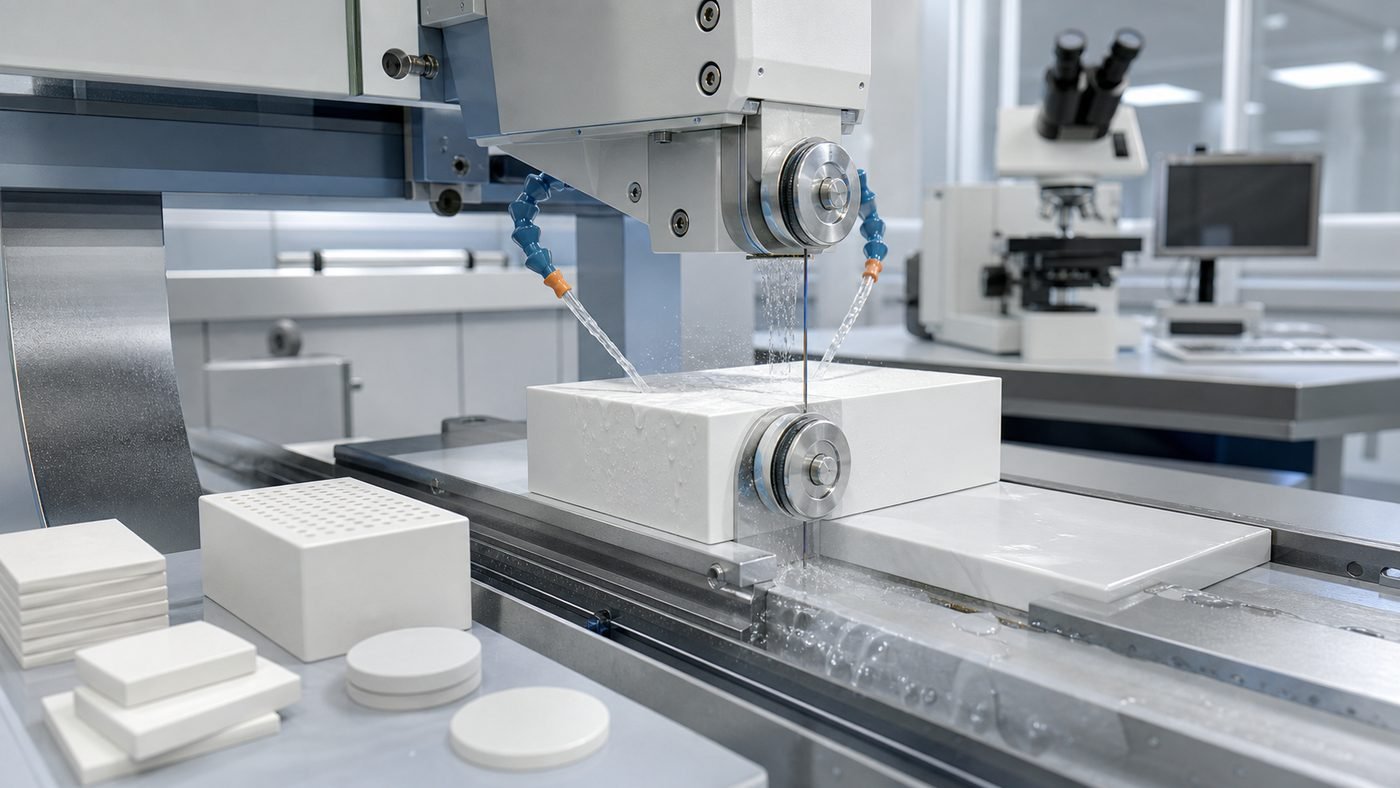
Advanced ceramics combine high hardness with low fracture toughness. Unlike metals, they do not deform much before failure. When cutting force rises too quickly, the material tends to chip, crack or release stored stress at the edge. This is especially important for thin ceramic substrate slicing, where a small defect can reduce usable area or create handling risk in later process steps.
The process window is also narrow because many ceramic parts have tight dimensional targets. Electronic ceramic substrates may need controlled thickness and parallelism before metallization. Structural zirconia cutting may require clean edges to avoid strength loss. Aluminum nitride cutting must balance thermal conductivity requirements with low surface damage. In these cases, hard brittle material cutting depends on stable feed, controlled wire speed, accurate fixturing and consistent coolant flow.
A conventional abrasive saw can separate the material, but it may apply higher local force or create a wider kerf. A diamond wire saw can reduce mechanical load when the wire, tension and feed are correctly matched to the ceramic. The benefit is practical: fewer rejected parts, less grinding allowance and a more predictable route from blank to finished component.
Common Problems in Ceramic Cutting
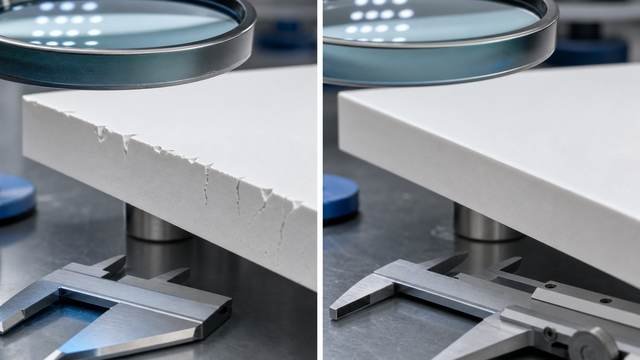
Edge chipping is usually the first defect operators notice. Chips often appear at entry and exit edges, around unsupported corners, or where cutting force changes suddenly. Even if the chip is small, it can reduce usable substrate area or require extra chamfering. When the part is an electronic ceramic substrate, poor edge quality may also complicate printing, coating or handling.
Microcracks are more dangerous because they are not always visible. They can form below the surface when the cutting load is unstable. Later lapping, thermal cycling or assembly stress may open those cracks and turn a seemingly acceptable part into scrap. Surface roughness is another cost driver. If the cut face is rough, the factory may need more grinding and polishing, which increases labor, consumable use and cycle time.
Other problems include wire breakage, thickness variation, excessive kerf loss, waviness and low batch consistency. Wire breakage stops production and can damage expensive material. Thickness drift increases sorting work and downstream correction. High kerf loss reduces material utilization, especially when cutting costly aluminum nitride, zirconia or specialty ceramic blanks.
How Diamond Wire Saw Technology Improves Ceramic Cutting Quality
A diamond wire saw removes material through abrasive action along a fine wire. Instead of forcing a rigid blade through the workpiece, the wire can cut with lower contact force when tension, speed and feed are balanced. This lower-stress cutting mechanism is useful for precision ceramic cutting because it reduces the tendency for brittle fracture at the edge.
Kerf width is another advantage. A fine diamond wire can create a narrower cut path than many blade-based processes, helping preserve more material. However, a narrow wire only helps if the machine keeps the wire stable. Poor tension control, vibration or weak fixturing can cause wire bow and produce a wider or uneven cut. Buyers should therefore evaluate machine rigidity, wire guide accuracy and tension stability instead of judging by wire diameter alone.
Coolant and debris evacuation also matter. Ceramic powder can accumulate in the cutting zone, increasing friction and heat. Stable coolant delivery removes debris, controls temperature and keeps the abrasive contact more predictable. For hard brittle material cutting, process stability often comes from these small details rather than from maximum machine power.
Endless Diamond Wire Saw, Diamond Multi-Wire Saw, or Desktop Loop Saw: Which One Should You Choose?
A desktop endless loop diamond wire saw is often the right starting point for laboratories, R&D teams and small sample preparation. It allows engineers to test new materials, evaluate chipping behavior and define early parameters without committing to a production-scale system. It is useful when the workpiece is small, the batch is limited, or the team needs flexibility for different shapes.
An endless diamond wire saw is suitable when the priority is high precision, special geometry, R&D validation or medium-volume cutting. The continuous wire loop supports stable wire motion and can be adapted for ceramics that need careful handling. For advanced ceramic cutting of special components, this configuration often gives engineers more room to tune feed, fixture support and cut path.
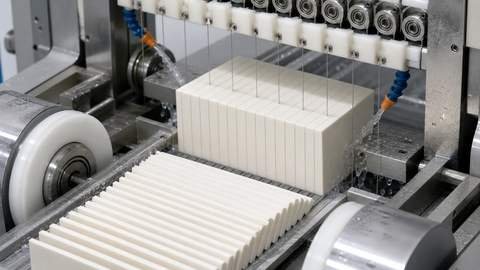
A diamond multi-wire saw is different. It is built for parallel slicing and higher throughput. If the project involves ceramic substrate slicing, aluminum nitride cutting, alumina plate slicing or other repeated thin-section work, the multi-wire configuration can improve capacity and wafer-to-wafer consistency. The tradeoff is that process control must be strong across many wires at once. Guide roller precision, wire spacing, coolant distribution and maintenance discipline become more important.
Key Parameters to Evaluate Before Buying a Ceramic Cutting Machine
Start with the actual material. Zirconia cutting, aluminum nitride cutting, alumina cutting and silicon nitride cutting do not behave the same way. Provide the supplier with material grade, dimensions, target thickness, tolerance, edge requirement and expected production volume. A good ceramic cutting machine recommendation should come from these details, not from a generic model list.
Next, define quality targets. What level of edge chipping is acceptable? Is the cut face only a preform surface, or will it go directly into polishing, metallization or bonding? How much thickness variation can downstream processes tolerate? These questions influence wire diameter, diamond grit, feed rate, wire speed, coolant strategy and fixture design.
Cost evaluation should include consumables. Diamond wire life, coolant filtration, guide wear, fixture wear and operator setup time all affect total cost. A cheaper machine with unstable wire consumption may cost more over a year than a better-controlled system. For procurement teams, the practical metric is cost per usable part, not only purchase price.
Finally, evaluate process support. Advanced ceramic cutting often needs trial cutting, parameter adjustment and failure analysis. If a supplier can help identify whether chipping comes from feed force, unsupported edges, coolant starvation or wire wear, the ramp-up risk is much lower.
Applications of Precision Ceramic Cutting
Precision ceramic cutting is used in aluminum nitride substrate slicing for power electronics and thermal management, zirconia cutting for structural ceramic components, alumina ceramic cutting for insulation and wear-resistant parts, and electronic ceramic substrate processing for sensors, circuits and packaging. Medical ceramic parts, semiconductor ceramic components and high-hardness ceramic fixtures also require controlled cutting to avoid hidden damage.
In many of these applications, the cut surface is only the beginning. The part may still require lapping, polishing, coating, metallization, bonding or inspection. A stable diamond wire cutting system process helps reduce the burden on those later steps. This is why precision ceramic cutting should be evaluated as a complete manufacturing route rather than a single machine operation.
How ewirexon Supports Precision Ceramic Cutting Applications
Ewirexon focuses on precision diamond wire cutting solutions for hard and brittle materials. Its product scope includes continuous-loop diamond wire cutting systems, multi-wire slicing equipment, desktop loop saw machines, diamond wire consumables and auxiliary processing equipment. For ceramic projects, this range gives engineers options for R&D trials, special-shaped parts, substrate slicing and higher-throughput production.
The useful discussion usually starts with the material and production problem. A team cutting a few zirconia prototypes does not need the same system as a factory slicing aluminum nitride substrates every day. Ewirexon can support equipment selection, consumable matching, fixture discussion and process parameter consulting around the actual part geometry, tolerance and output target. That is more valuable than treating every ceramic application as the same cutting task.
Conclusion
Choosing the right diamond wire cutting system for precision ceramic cutting means balancing material behavior, edge quality, surface finish, kerf loss, throughput and long-term operating cost. Desktop loop systems help with laboratory and sample work. A continuous-loop wire saw supports flexible precision cutting and special shapes. A multi-wire slicing system fits higher-volume ceramic substrate slicing when process stability is well controlled.
Before requesting a proposal, prepare the ceramic type, dimensions, target thickness, tolerance, surface quality requirement, expected capacity and current cutting problems. Those details make it much easier to choose cutting equipment that improves yield instead of simply adding another cutting step.
FAQ
What is the best cutting method for advanced ceramics?
For many precision ceramic cutting applications, diamond wire cutting system technology is preferred because it can cut hard brittle materials with lower mechanical stress, narrower kerf and better edge control than many conventional methods. The best configuration depends on part size, tolerance and production volume.
Why is diamond wire saw suitable for ceramic cutting?
A diamond wire cutting system uses fine diamond abrasive on a moving wire, which helps process hard ceramics while controlling cutting force. With stable tension, coolant and feed, it can reduce edge chipping, surface damage and material waste.
How can manufacturers reduce edge chipping in ceramic cutting?
Manufacturers can reduce edge chipping by lowering feed force, improving fixture support, choosing the right wire grit, keeping tension stable, controlling coolant delivery and avoiding worn wire or guide components.
What is the difference between endless diamond wire saw and diamond multi-wire saw?
A continuous-loop wire saw uses a continuous loop and is often better for R&D, special shapes and precision small batches. A multi-wire slicing system uses many parallel wires and is better for higher-throughput ceramic substrate slicing.
How to choose cutting equipment for hard brittle materials?
Start with material type, workpiece size, thickness target, tolerance, edge quality, surface finish and capacity. For hard brittle material cutting, also compare machine rigidity, wire tension control, coolant management, consumable cost and supplier process support.