






Wafer manufacturers are under pressure from several directions at once. Semiconductor fabs need stable substrates for power devices, sensors, optoelectronics and AI-related infrastructure. Photovoltaic manufacturers continue to push thinner wafers, higher cell efficiency and lower cost per watt. SiC, silicon, sapphire and other advanced substrates all demand better material utilization and more consistent slicing quality.
In this environment, the diamond multi-wire saw has become an important production tool. Its value is not just that it cuts many wafers at once. The real value is the combination of throughput, kerf loss reduction, thickness consistency and process repeatability. For procurement managers, this changes the equipment decision from machine price to cost per usable wafer.
This article explains how diamond multi-wire saw technology supports semiconductor wafer cutting and photovoltaic wafer slicing, what problems it helps solve, and what factories should evaluate before choosing a production system.
Why Wafer Slicing Economics Are Changing
In both semiconductor and photovoltaic production, the wafer is a cost-sensitive platform. For power electronics, SiC and other compound semiconductor substrates are expensive to grow and difficult to process. For solar manufacturing, wafer thickness, yield and kerf loss directly influence module cost. In both cases, slicing is one of the first steps where material can be preserved or wasted.
Industry trends make this more important. Power devices are growing with electric vehicles, renewable energy, data centers and high-efficiency industrial power systems. AI infrastructure increases demand for efficient power conversion and reliable thermal management. At the same time, PV manufacturers keep pushing higher-efficiency cell architectures and thinner wafers. These trends reward factories that can cut more usable wafers from the same ingot or boule.
A production slicing system must therefore do more than run fast. It must maintain predictable kerf, stable thickness, controlled surface damage and acceptable wire consumption over long production cycles.
How a Diamond Multi-Wire Saw Works
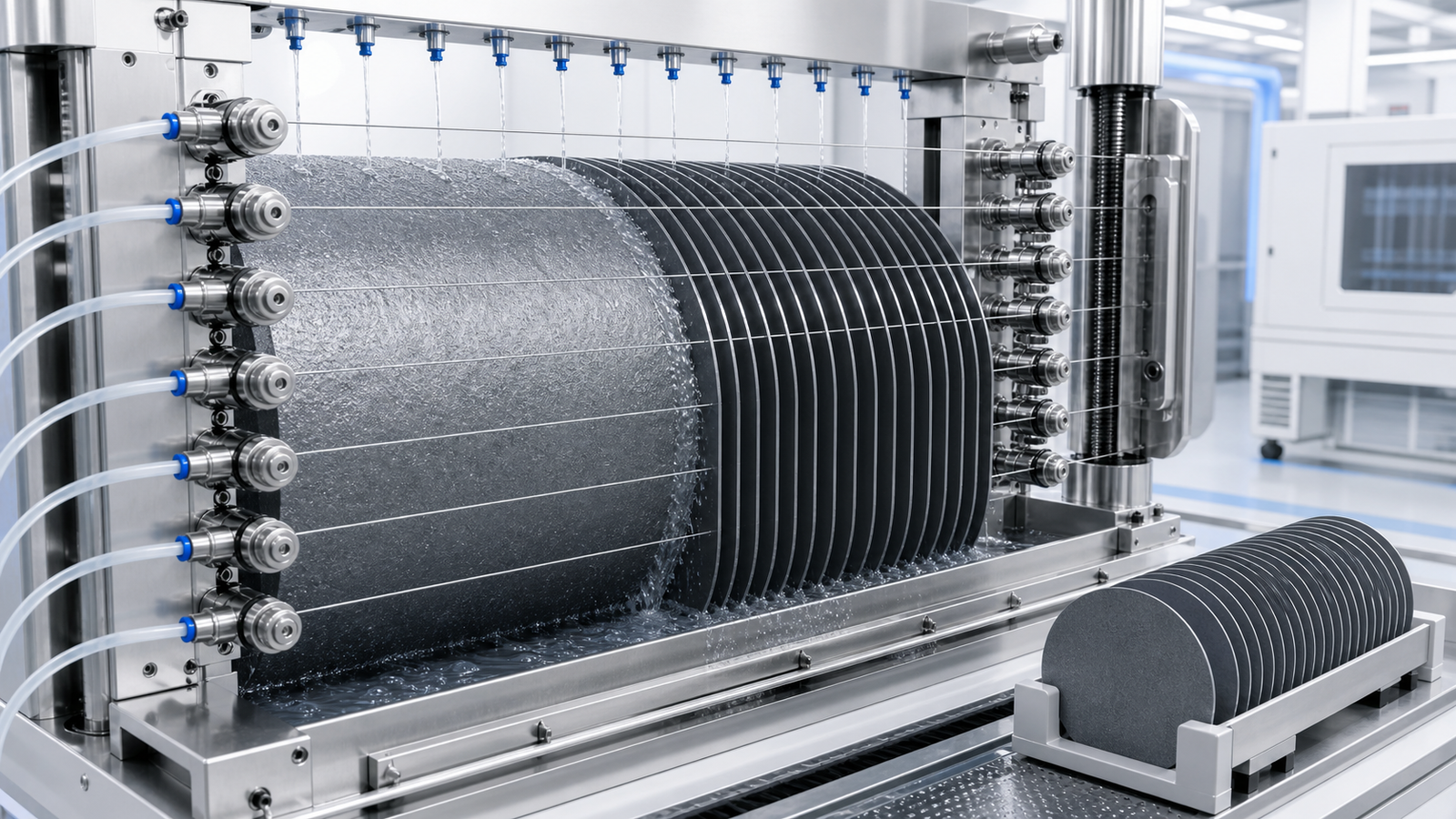
A diamond multi-wire saw uses many parallel diamond wires stretched across guide rollers to slice a workpiece into multiple wafers simultaneously. Diamond abrasive grains on the wire remove material as the wire moves through the ingot or block. Coolant removes heat and carries debris away from the cutting zone.
Compared with single-wire cutting, the advantage is parallel processing. One cycle can produce many slices, which improves throughput. Compared with wider cutting methods, fine diamond wire can reduce kerf width and preserve more material. The challenge is control: every wire in the web must remain stable, properly tensioned and well-cooled.
For silicon wafer slicing, the process supports high-volume wafer output. For SiC substrate slicing, it must also manage high hardness, brittleness and higher material cost. For PV wafer processing, it supports the ongoing need for thinner wafers and improved material utilization.
Kerf Loss Reduction and Yield Control
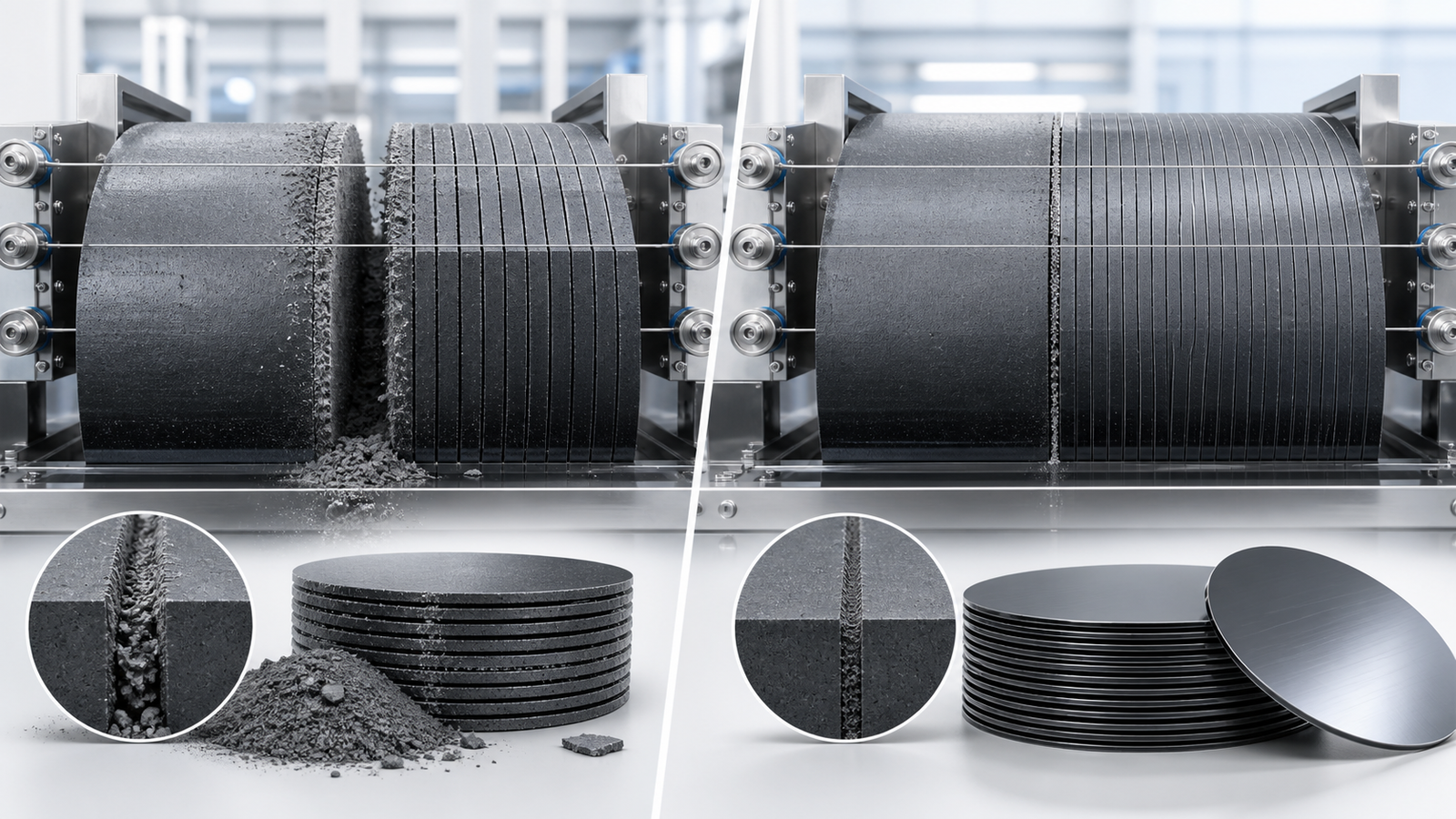
Kerf loss reduction is one of the clearest reasons to use diamond wire technology. Kerf is the material removed by the wire. Once removed, it becomes powder or slurry and cannot become a wafer. When the raw material is expensive, even a small improvement in kerf can affect total wafer output.
However, kerf reduction is not achieved by wire diameter alone. A thin wire that vibrates or bows can create an unstable cut. The machine must maintain wire tension, guide accuracy and stable feed motion. Coolant must prevent debris loading, because trapped particles can scratch surfaces and increase cutting resistance.
Yield also depends on avoiding cracks, edge chips and excessive thickness variation. A wafer with low kerf but poor geometry may still require heavy downstream processing or may fail inspection. The production goal is not simply thin cutting. It is repeatable, low-damage slicing that produces usable wafers.
Common Production Problems in Multi-Wire Wafer Cutting
Wire breakage is one of the most disruptive problems. It can stop production, damage the workpiece and create downtime for re-threading or cleanup. Causes may include excessive feed force, unstable tension, poor wire quality, guide wear, insufficient coolant or debris accumulation.
Thickness variation is another common issue. If the wire web is not stable, wafer thickness may vary across the batch. This increases downstream grinding load and can reduce yield. For semiconductor substrates, geometric consistency is critical because later processes assume stable wafer shape.
Surface damage is often less visible but equally important. Microcracks and scratches can increase polishing time or reduce device reliability. Materials such as SiC, sapphire and ceramics are especially sensitive because they are hard and brittle. A strong production process must control both visible defects and hidden damage.
Consumable drift also matters. Diamond wire changes as it wears. Guide rollers, coolant filters and fixtures also age. A stable production line needs maintenance intervals and inspection criteria, not only a good first cutting result.
What to Evaluate Before Choosing a Diamond Multi-Wire Saw
Start with the workpiece. Define material, diameter or block size, target wafer thickness, tolerance, surface requirement, daily output and downstream process limits. A PV wafer line, SiC substrate line and sapphire slicing process may all use diamond wire, but they do not need the same process window.
Next, evaluate machine stability. Ask how the system controls wire tension, guide roller accuracy, feed motion, coolant delivery and vibration. In a multi-wire saw, small instability is multiplied across many wires. This is why mechanical rigidity and process monitoring are essential.
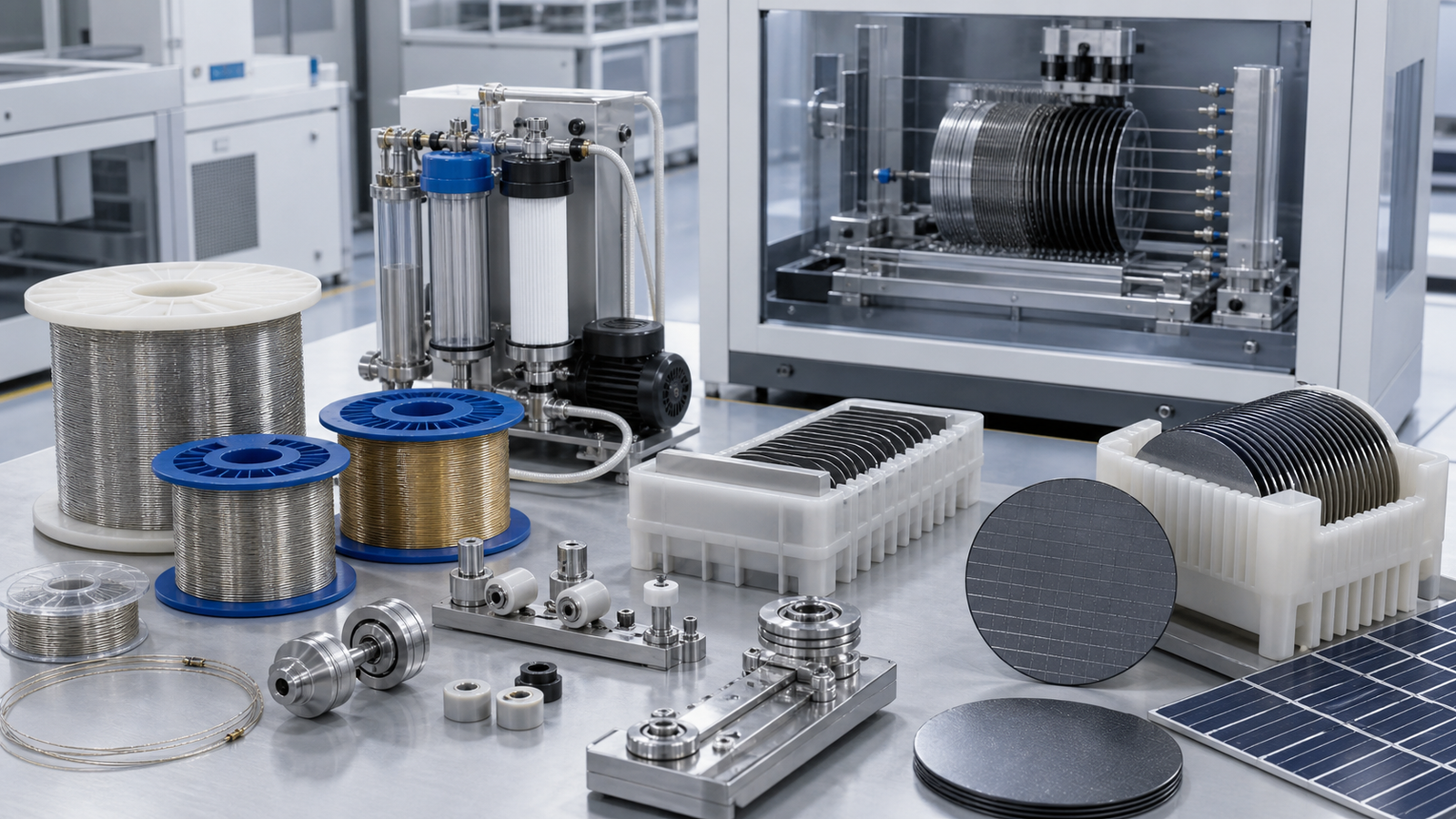
Consumables should be part of the selection. Diamond wire diameter, grit, bonding and wire life affect kerf loss, surface quality and cost. Auxiliary systems such as coolant filtration, loading fixtures, wafer carriers and cleaning support can determine whether the line stays stable after the first trial.
Finally, evaluate supplier support. Production wafer slicing often needs parameter optimization after installation. A supplier that understands process parameter consulting, operator training and maintenance can reduce ramp-up risk.
Where Ewirexon Multi-Wire Saw Solutions Fit
Ewirexon provides precision diamond wire cutting systems for hard and brittle materials, including diamond multi-wire saw solutions, endless diamond wire saw equipment, desktop endless loop diamond wire saw machines, consumables and auxiliary processing equipment. Its application areas include diamond wire saw products for precision cutting, silicon wafer slicing, SiC and compound semiconductors, sapphire, advanced ceramics, quartz crystal, optical glass, photovoltaic materials, graphite, magnetic materials and special crystals.
For a production wafer project, the important question is not only whether a machine can cut. It is whether the system can reach the required wafer quality, output and operating cost with the actual material. Ewirexon can support this evaluation through material-focused equipment selection, process discussion and customized cutting system development when standard configurations are not enough.
For factories moving from R&D to pilot production, an endless diamond wire saw may help validate parameters before scaling. For higher-volume wafer slicing, a diamond multi-wire saw may be the better path. For mixed materials or non-standard substrates, fixture design and auxiliary processing become part of the solution.
Conclusion
Diamond multi-wire saw technology matters because wafer slicing economics are becoming tighter. Whether the material is silicon, SiC, sapphire or photovoltaic silicon, factories need more usable wafers, less kerf loss, stable thickness and fewer process interruptions.
The right system should be selected around material behavior, wafer specification, production target and long-term operating cost. A good cutting result is not just a smooth surface after one test. It is a repeatable process that maintains yield over time.
Before requesting a proposal, prepare the material type, dimensions, target thickness, tolerance, surface requirement, expected output and current cutting pain points. These details help determine whether a diamond multi-wire saw, an endless diamond wire saw or a customized diamond wire cutting system is the most practical choice.
FAQ
What is a diamond multi-wire saw used for?
A diamond multi-wire saw is used to slice multiple wafers or plates at the same time. It is common in semiconductor wafer cutting, photovoltaic wafer slicing, SiC substrate slicing and other applications where throughput and consistency matter.
How does diamond wire cutting reduce kerf loss?
Fine diamond wire creates a narrow cutting path. When tension, feed, coolant and wire motion are stable, the process removes less material and improves usable wafer output from the same ingot.
Is a diamond multi-wire saw suitable for SiC wafer cutting?
Yes, but the process must be carefully controlled because SiC is hard, brittle and expensive. Wire tension, coolant flow, feed rate, wire condition and machine rigidity are critical.
What is the difference between diamond multi-wire saw and endless diamond wire saw?
A diamond multi-wire saw is designed for parallel slicing and production output. An endless diamond wire saw uses a continuous wire loop and is often better for R&D, precision samples, special materials and small batches.
What should procurement teams compare besides machine price?
Compare kerf loss, wafer yield, thickness consistency, wire consumption, uptime, maintenance access, coolant and auxiliary systems, process support and the supplier’s ability to run material-specific cutting trials.