










What causes diamond wire saw power to rise?
Possible causes include increased contact length, changed feed, abrasive condition, poor flushing, mechanical drag and sensor drift. Compare idle and cutting baselines before assigning the change to wire wear.
A drive-current trace is useful because it is accessible, but it is not a direct measurement of cutting force. Motor efficiency, speed and mechanical losses affect the signal. Treat it as a correlated process indicator whose interpretation needs a repeatable baseline.
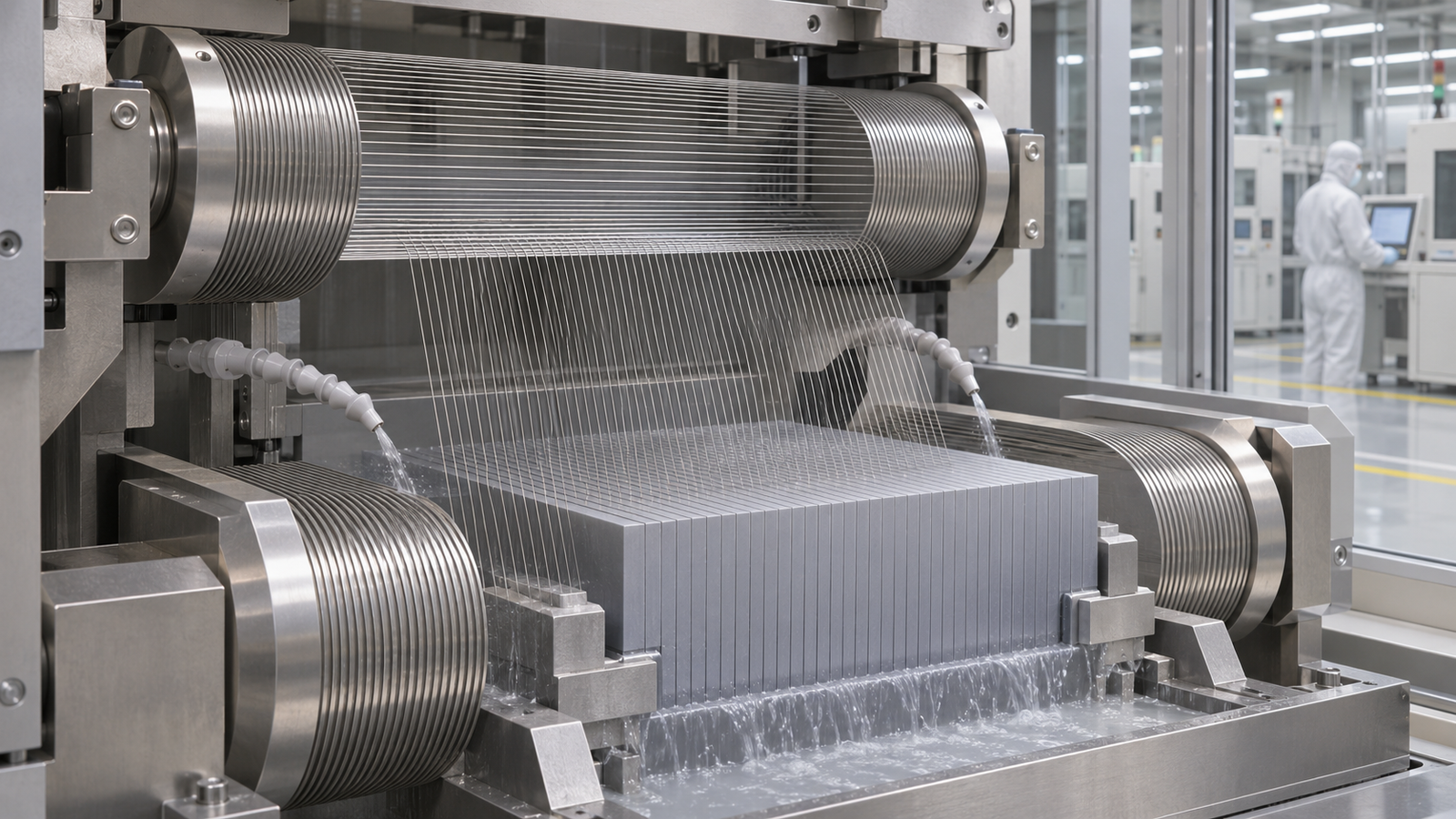
Start with idle power
Compare the machine at the same wire speed without workpiece engagement, following approved operating procedures. If idle load has risen, inspect guides, bearings, tracking and fluid-related drag before changing feed. Keep guards closed and use approved maintenance isolation for physical checks.
Normalize for engagement
A cylindrical boule presents changing contact length. The center of the cut cannot be compared directly with entry. Plot drive load against feed position and compare equivalent depth intervals across runs. Preserve actual speed and feed, not just recipe setpoints.
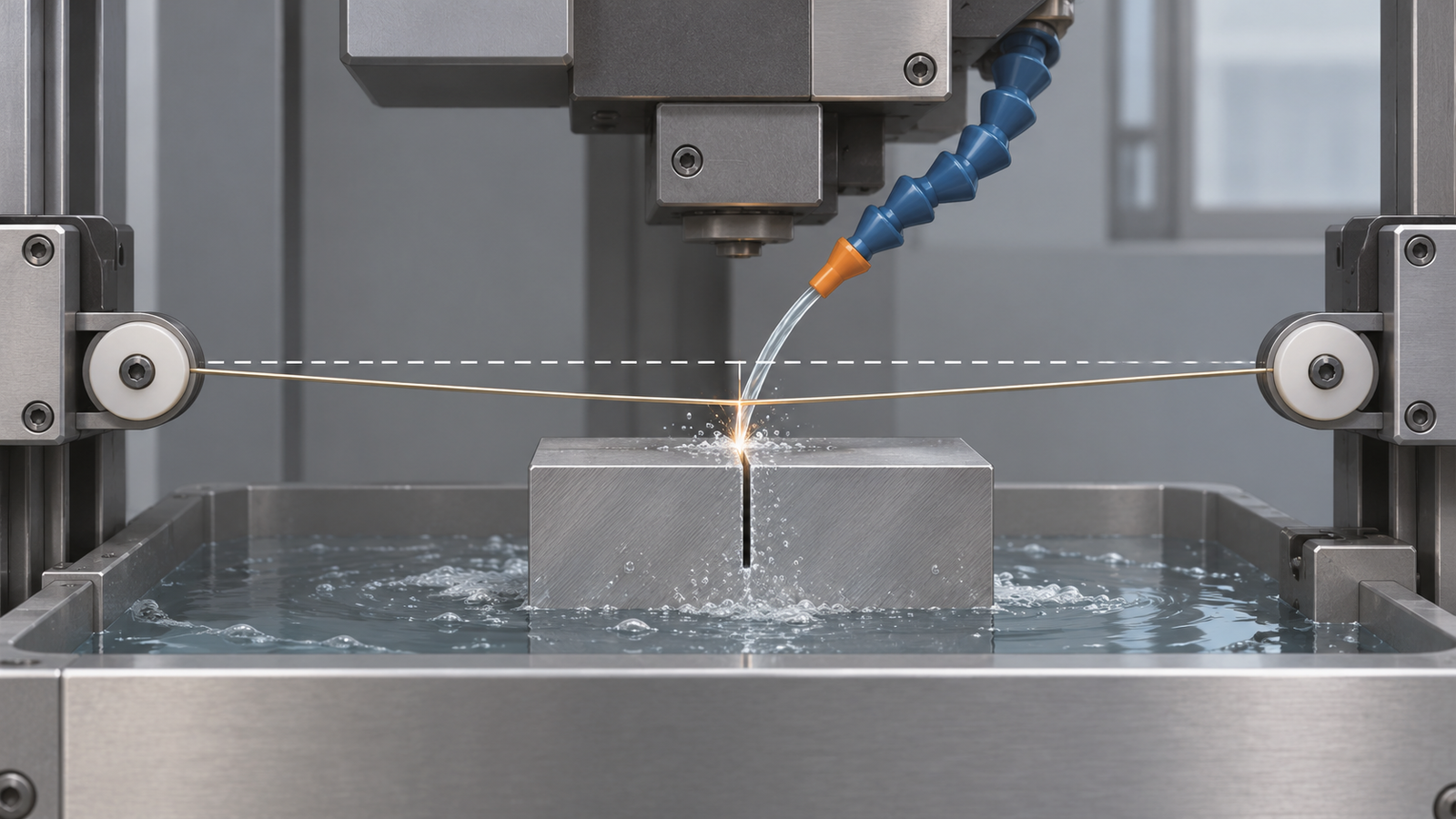
Check the fluid circuit
Confirm flow at the cutting zone, nozzle position, filter pressure and coolant temperature. Pump operation alone does not prove that debris is leaving the kerf. A blocked nozzle can create a local load change while total pump flow appears normal. Correct the delivery problem and repeat the same reference interval.
Separate wire wear from material variation
Record material grade, dimensions, orientation and wire exposure. Compare a reference material if production lots differ. Abrasive wear does not always cause a monotonic force increase: experimental silicon results include a stable-wear stage with decreasing force. Inspect wire condition and wafer outputs alongside the trace.

Use multiple signals
Compare power with tension response, feed load, wire bow and surface maps. A 2026 study demonstrates the use of process data to estimate wire bow on an industrial multi-wire saw. That supports combining signals, but its model accuracy cannot be assumed for another machine or material.
Make one controlled correction
Freeze the logs and identify a predicted cause before adjustment. After correction, compare equivalent cutting intervals and inspect the wafer region linked to the event. Changing coolant, tension and feed together may recover the cut but destroys the evidence needed to prevent recurrence.
Procurement implications
Request exportable timestamps, units, sampling intervals and recipe revisions. Demonstrate an actual file export during FAT. For an endless diamond wire saw or diamond multi-wire saw, data access is valuable only when it can be connected to accepted parts. Ask ewirexon to define available signals for the specific configuration rather than assuming every model has identical sensing.
Related process guidance
See related process guidance, the FAT checklist and ewirexon cutting systems.
Frequently asked questions
Can one trial prove production consistency?
No. Repeat across representative material and wire conditions.
Should nominal settings be recorded?
Record both setpoints and actual signals where available.
Which quality outputs matter?
Geometry, chips, surface damage, finishing allowance and accepted yield.
Can results transfer from silicon to SiC?
Not without material-specific validation.
Where should a cutting trial start?
With the drawing, material specification, acceptance limits and baseline process.
Reference
Wire-bow prediction from process signals. The recommendations are engineering guidance, not measured supplier performance.