
High-purity quartz is easy to describe as “glass” and difficult to manufacture as a semiconductor process component. A furnace tube, ring, boat, liner or thick optical blank may look clean after separation but still carry edge cracks, embedded particles or chemical residues that become failures during machining, cleaning or high-temperature service.
Demand is tied to semiconductor and photovoltaic manufacturing because fused quartz components and crucibles combine thermal stability, purity and optical properties. The 2026 U.S. Geological Survey mineral summary specifically connects increased semiconductor and photovoltaic silicon manufacturing with demand for high-purity quartz used in fused-quartz crucibles. For component makers, that makes material yield and contamination discipline more valuable: qualifying feedstock is expensive and replacement supply is not always simple.
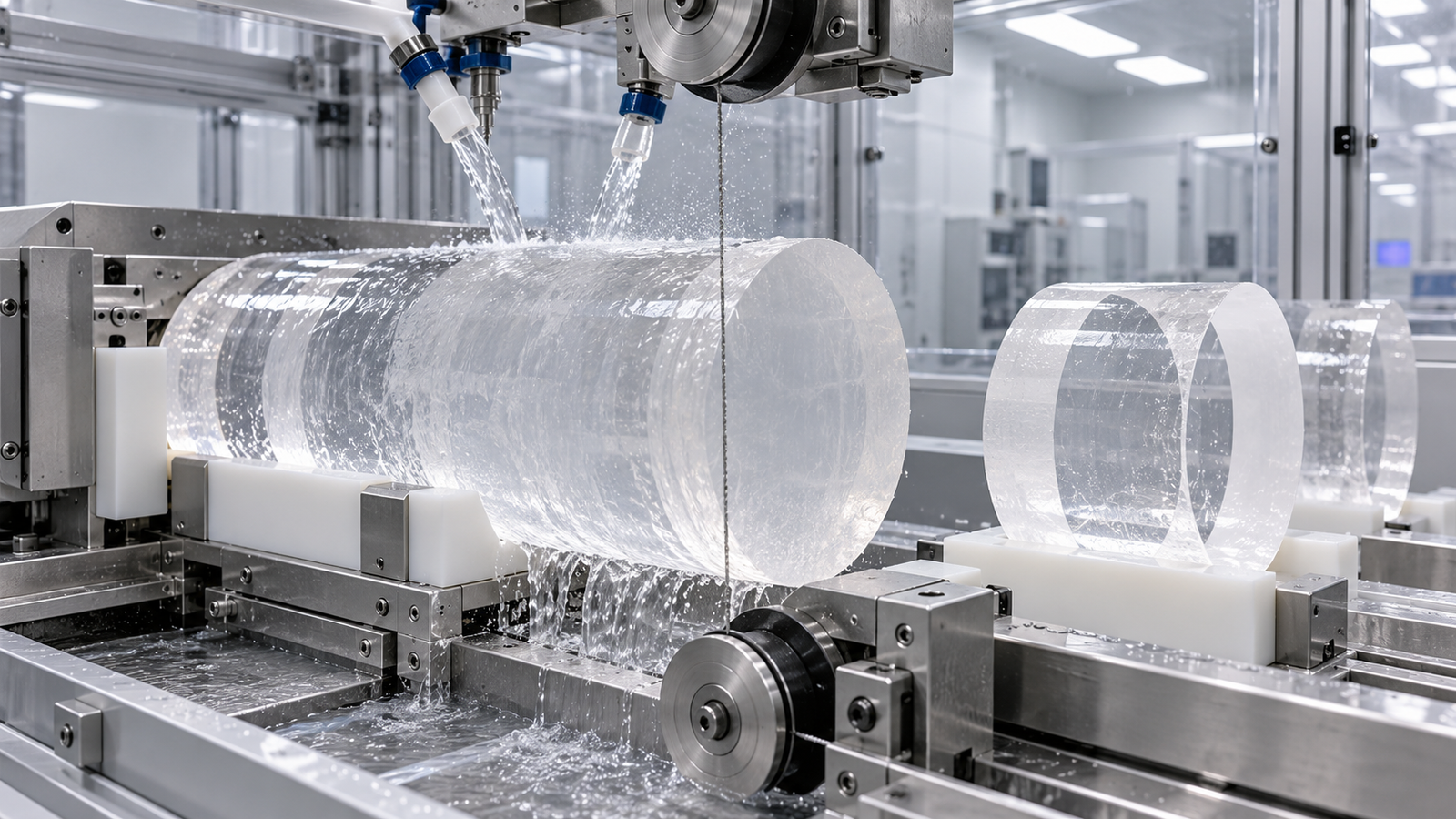
A diamond wire saw can prepare plates, rings, blocks and machining blanks with a narrow kerf and low cutting force. It does not by itself create the final clean surface. This guide shows how to connect slicing, finishing and cleaning so a geometrically good cut does not become a rejected semiconductor component.
Quartz terminology matters
Crystalline quartz and fused quartz are not interchangeable. Crystalline quartz is anisotropic and has crystallographic directions. Fused quartz or fused silica is amorphous, although its properties still vary with feedstock, hydroxyl content, manufacturing route and thermal history. Semiconductor equipment commonly uses high-purity fused quartz, while optical and resonator applications may use different grades or crystalline material.
The process traveler should identify the exact grade, supplier lot, forming route, annealing state, impurity specification and whether the part has flame-worked, ground, polished or coated regions. A recipe qualified on an optical-grade plate should not automatically be released for a high-purity furnace component.
Why semiconductor quartz cutting is difficult
Quartz combines brittleness with demanding cleanliness. Diamond grains can remove the material efficiently, but each grain contact can also launch a crack. A visible edge chip is only the surface expression; smaller subsurface cracks may remain below an apparently smooth face. Residual stress from forming or local heating can make damage unpredictable.
The production risks include:
- entry and exit chips that reduce machining allowance;
- subsurface damage exposed during grinding, polishing or thermal cycling;
- wire marks and waviness that increase downstream stock removal;
- particle embedding from abrasive, bond, guides or recirculated debris;
- ionic or organic residue from coolant, adhesive and cleaning chemistry;
- cross-contamination from previous materials cut on the same machine.
The correct output is therefore not simply a separated blank. It is a traceable blank with enough sound material for the qualified finishing and cleaning route.
Map contamination pathways before the first cut
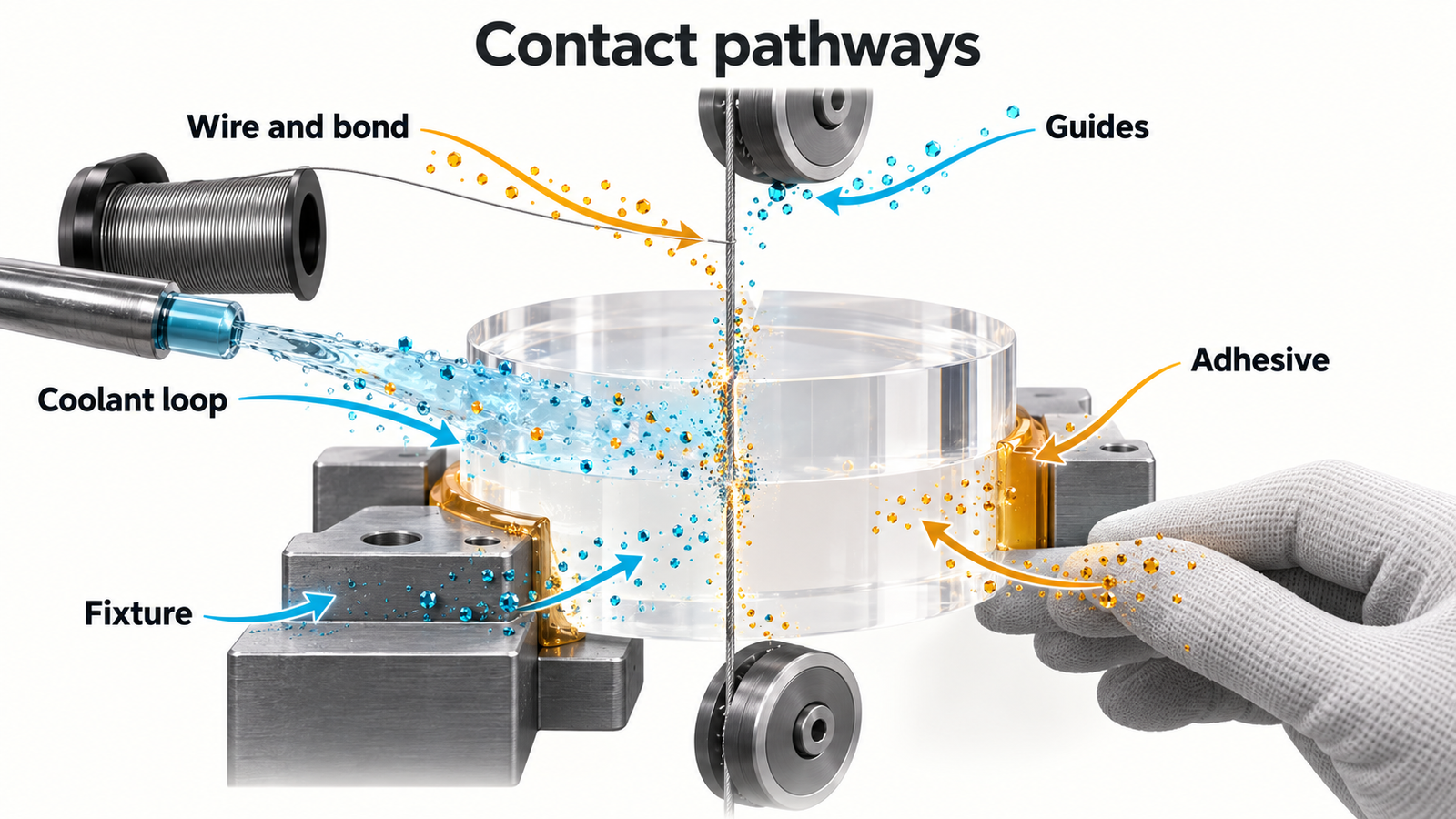
Semiconductor cleanliness cannot be added at the final rinse. List every surface and fluid that can contact the part or return particles to the kerf. The list usually includes wire and bond chemistry, guide wheels, workholding pads, adhesives, coolant, tanks, pumps, filters, hoses, nozzles, handling gloves, trays and cleaning fixtures.
Separate three questions:
- What contamination can the cutting process introduce? Consider metals, abrasive fragments, polymers, oils, corrosion products and biological growth in water systems.
- Can the next cleaning step remove it? Verify with the actual chemistry, time, temperature and agitation, not a generic statement that the part is washable.
- Can cleaning attack the damaged surface? A crack network can retain particles or enlarge during etching, turning latent damage into visible defects.
For shared equipment, define material-family segregation and cleaning verification. Graphite, ceramics, metals and quartz should not rotate through the same wet path without a documented contamination assessment.
Wire selection is a total-loss decision
Wire diameter and abrasive envelope establish much of the geometric kerf. Smaller abrasive and lower protrusion may improve the as-cut texture, but removal capacity can fall. If the wire rubs or bows, cutting time, waviness and subsurface damage may increase. A slightly wider stable cut can consume less total material after grinding than a nominally narrow unstable cut.
Evaluate candidate wires using:
- measured kerf at several positions, not nominal wire diameter;
- cutting force or drive-load trend through changing contact length;
- edge-chip distribution at entry, sidewall and exit;
- directional surface profiles and waviness;
- finishing stock required to remove saw damage;
- wire wear, particle shedding and accepted area per wire.
The site’s diamond wire selection guide provides a practical framework for diameter, grit and bond trials.
Support design controls edge strength
The final ligament is a frequent failure point. As the wire approaches exit, the remaining quartz cannot carry the same load and a large chip may release. Support the exit face with a compatible sacrificial material or bonded plate, and ensure the adhesive does not create a hard discontinuity that redirects cracks.
Support qualification should include adhesive cure, stiffness, removal chemistry, thermal expansion, trapped particles and flatness. The unloading tool matters too. A thin ring or plate can survive cutting and crack when an operator pries it from the fixture.
For irregular components, model the contact-length profile. Feed may need to reduce as contact grows or edge support weakens. A constant machine feed is easy to program but does not create constant grain load.
Coolant, filtration and temperature control
Coolant transports heat and debris away from the wire-work interface. In quartz cutting, it also becomes a contamination carrier. Control incoming water quality or fluid concentration, tank temperature, filter differential pressure, solids loading, microbial condition and change interval. Sample from the delivery point and return path when troubleshooting.
Place nozzles so both sides of the kerf receive flow through the full cut. Excessive jet pressure can move a fine wire or fragile part; insufficient flow causes debris recutting. Record actual pressure or flow after the filter rather than relying only on pump settings. See the coolant and debris-removal guide for a control plan.
Build a cut-to-clean qualification
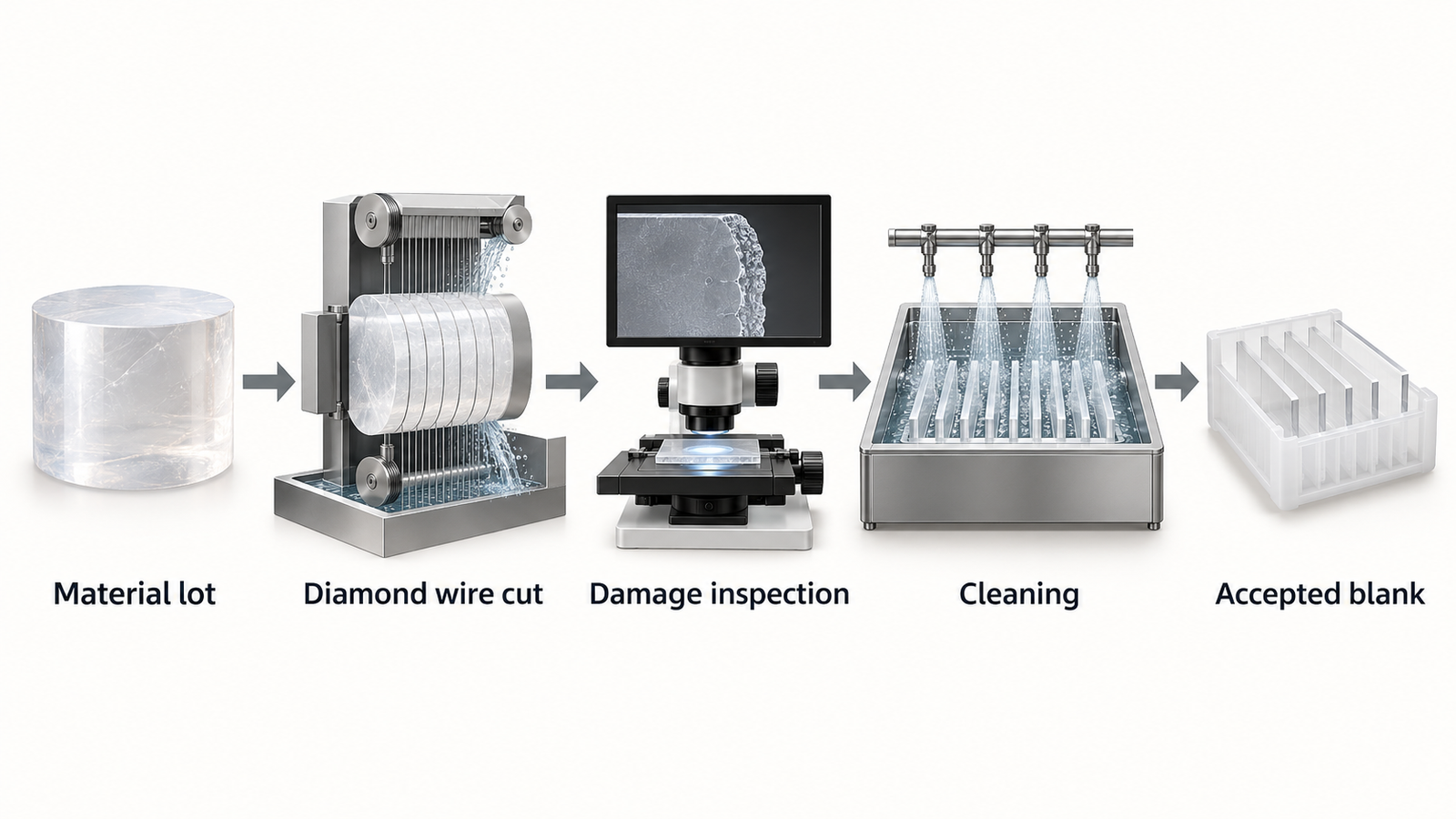
Separating the cutting trial from downstream cleaning creates a gap in accountability. Qualify the chain as one process:
- Define the final component risk. Identify high-temperature, plasma-facing, optical or sealing surfaces and their exclusion zones.
- Characterize incoming material. Record grade, lot, stress history, dimensions and existing surface condition.
- Cut mapped coupons. Preserve entry, exit and wire-travel direction. Record machine signals and coolant state.
- Measure as-cut geometry. Include kerf, thickness, flatness, chips, roughness and waviness.
- Assess damage depth. Use a validated cross-section, etch or stock-removal method on representative samples.
- Run the production cleaning route. Include adhesive removal, rinsing, drying and handling.
- Test cleanliness. Select particle, ionic or elemental methods based on the end-use specification.
- Complete finishing. Confirm the required grinding and polishing allowance and final acceptance yield.
Use blanks from multiple material lots and test a conditioned wire, not only a fresh one. If the part will see thermal cycling, include a representative thermal validation because latent cracks can open after the cutting inspection.
Endless and multi-wire saw roles
An endless diamond wire saw for quartz and optical glass is practical for thick components, development coupons, rings, small batches and special profiles. It offers fixture flexibility and access for contamination studies. A desktop endless loop system can support laboratory-scale material screening where samples are limited.
A diamond multi-wire saw is useful when repeated parallel quartz plates or wafers justify a wire web. Its productivity comes with additional qualification: lane pitch, guide condition, uniform coolant delivery and safe unloading of multiple brittle parts. Each part should retain lane identity during the trial.
Choose architecture from geometry and accepted volume, not from the assumption that multi-wire is always production and endless is always laboratory. Thick, complex semiconductor quartz components may remain better suited to a flexible single-loop machine even at recurring volume.
Procurement data that prevents later disputes
| Requirement | What to specify |
|---|---|
| Material | Exact quartz grade, lot range, annealing/forming history and purity needs |
| Geometry | Blank drawing, datum, kerf allowance, flatness and minimum wall |
| Damage | Chip classes, inspection magnification, SSD method and finishing allowance |
| Cleanliness | Prohibited materials, coolant limits, cleaning route and test method |
| Capacity | Accepted blanks per shift, changeover and cleaning time |
| Evidence | Raw trial data, sample traceability, wire state and nonconforming results |
How ewirexon supports semiconductor quartz applications
Ewirexon develops endless diamond wire saw, diamond multi-wire saw and supporting process solutions for quartz crystal, optical glass, SiC, silicon, sapphire and ceramics. For semiconductor quartz, the starting information should include the material grade, component drawing, functional surfaces, contamination restrictions, finishing route and output target.
A sample cutting trial can compare wire, support and coolant settings while preserving parts for cleaning and finishing evaluation. Where standard equipment does not provide suitable fixtures or clean material paths, custom equipment development should begin from measurable acceptance outputs rather than a general clean-machine label.
Conclusion
High-purity quartz cutting is a coupled fracture and contamination problem. Narrow kerf matters, but it has value only when edge damage, finishing stock and cleanability remain controlled. A diamond wire saw can reduce force and material loss when the wire, support, coolant and handling system are qualified together.
For engineers and buyers, the most useful equipment trial follows the blank beyond separation. Measure damage, complete the real cleaning and finishing route, and calculate cost per accepted component. That approach protects expensive quartz and creates evidence that can survive both process review and supplier qualification.
Frequently asked questions
Can a diamond wire saw cut high-purity fused quartz?
Yes. It can prepare blanks, plates, rings and other components with low cutting force. Wire, coolant, fixture and cleaning compatibility must be qualified for the purity requirement.
What causes edge chipping in quartz cutting?
High local grain load, poor exit support, vibration, residual stress and debris recutting are common causes. Chip position relative to entry and exit helps diagnose them.
Does a narrow kerf always reduce quartz material loss?
No. An unstable fine wire can increase waviness and subsurface damage, requiring more finishing stock. Compare total loss through final acceptance.
How should quartz cutting contamination be controlled?
Map every contact material and fluid, segregate incompatible materials, monitor coolant and filtration, validate cleaning and test particles or elemental residues according to end use.
Should quartz components use an endless or diamond multi-wire saw?
Endless systems suit thick, special and small-batch parts. Multi-wire systems suit repeated parallel slices when lane uniformity, coolant delivery and handling are qualified.
Technical references
- U.S. Geological Survey, Quartz Crystal (Industrial), Mineral Commodity Summaries 2026.
- Review of high-purity quartz purification and impurity control, 2025.
- OECD review of sand and silicate supply chains.
Editorial note: Cleanliness limits must come from the actual semiconductor process and material specification. The figures are AI-generated engineering illustrations, not customer installations or certified contamination-flow diagrams.