










How should a new diamond wire supplier be qualified?
Compare the candidate with the approved wire on matched material, using controlled machine conditions and multiple wire-life stages. Release the change only after geometry, damage, reliability and downstream yield meet predefined limits.
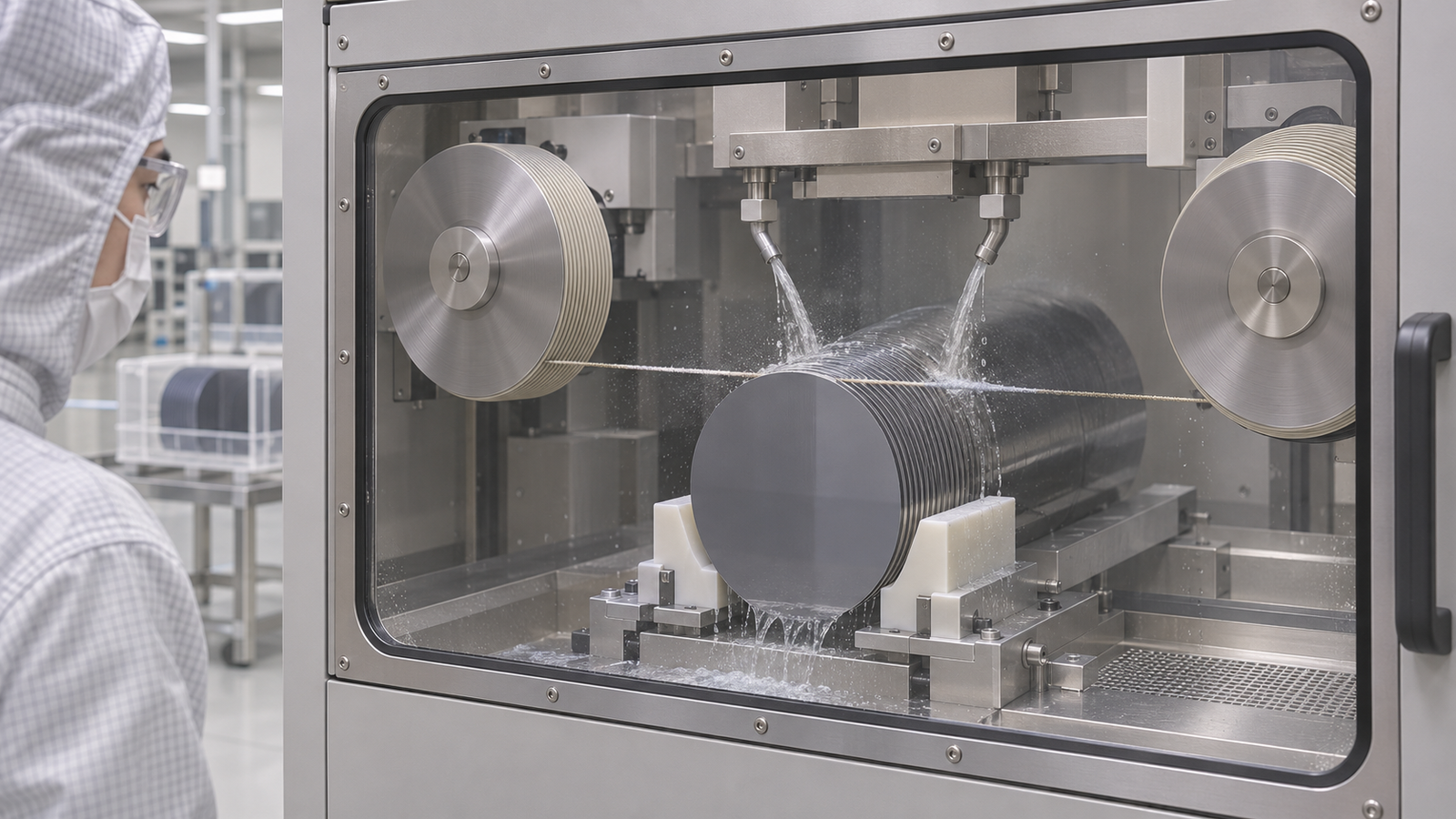
Nominal diameter is not a complete wire specification. Core properties, abrasive distribution, protrusion, bond and manufacturing consistency affect how a diamond wire saw behaves. A supplier change is therefore a process change, even when the purchase description appears unchanged.
Define the equivalence claim
List what must remain equivalent: actual abrasive envelope, breaking-load documentation, bend compatibility, surface requirements, contamination restrictions and traceability. Do not assume equal grit labels describe identical particle populations. Request inspection methods and lot certificates rather than an unsupported claim of interchangeability.
Use a matched baseline
Run the approved wire on representative material immediately before the candidate trial. Record guide condition, alignment, tension calibration, fixture, coolant and contact length. If those inputs change between tests, the comparison cannot isolate the wire. For SiC substrate slicing, preserve crystal orientation and material lot.
Separate conditioning from stable use
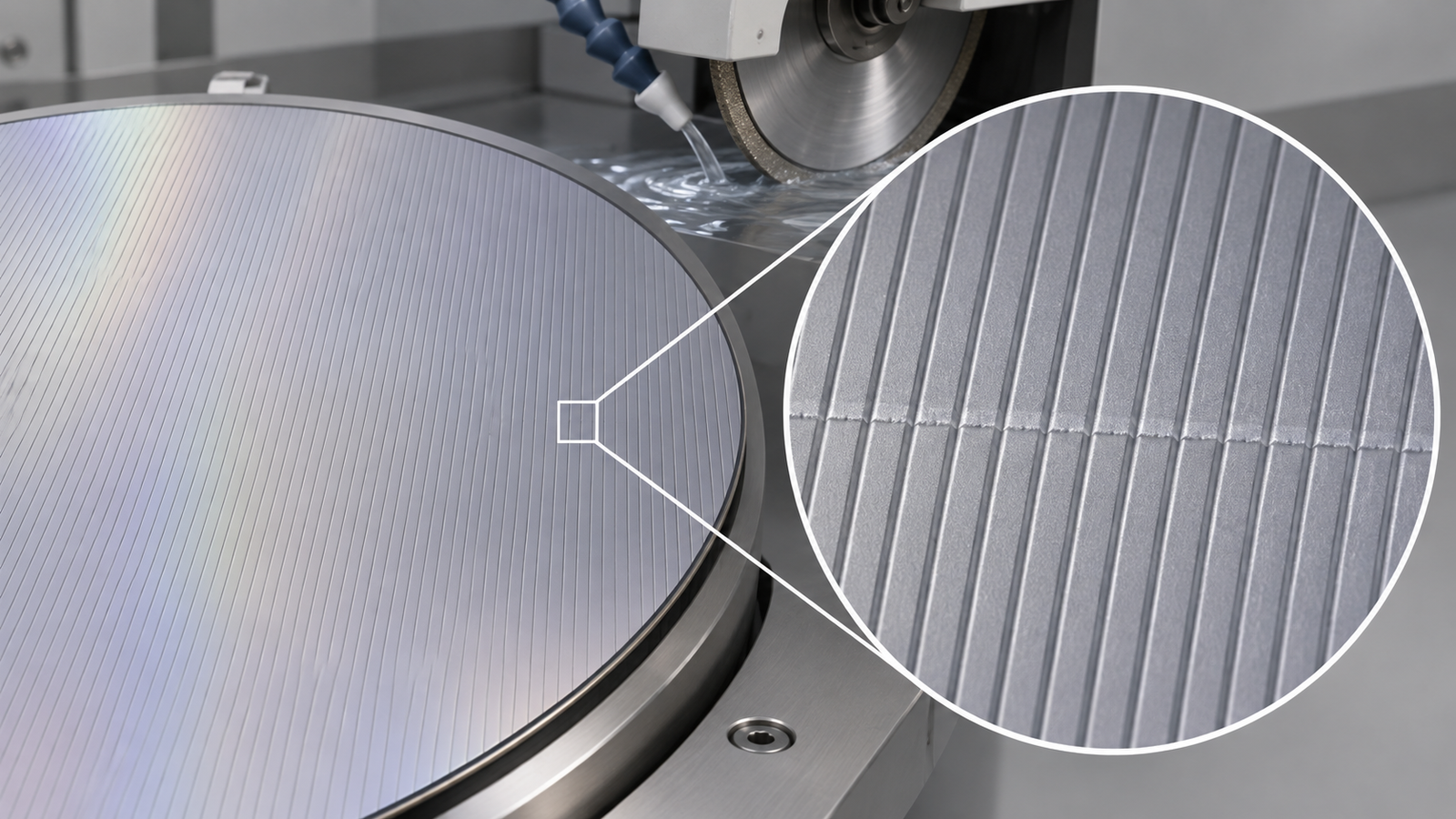
A new wire can behave differently during initial conditioning. Establish that period before comparing average cutting force or roughness. Experimental silicon research shows that force and surface behavior can change through wear; a rising-force assumption is not universal. Record each candidate’s trajectory rather than judging only its first cut.
Measure accepted output
Track kerf, cycle time, chips, directional profiles, thickness maps and finishing stock. Include broken and rejected parts. A finer wire that lowers kerf but increases finishing loss may cost more per accepted wafer. On a diamond multi-wire saw, retain lane position and examine edge lanes separately.

Test reliability before release
Include normal loading, planned stops and later-life exposure within the approved operating procedure. Do not deliberately exceed machine limits to accelerate a trial. Sample more than one candidate lot before claiming supply consistency. Record storage and handling because core damage can precede installation.
Build change control into purchasing
Agree on lot identification, notification of bond or core changes, sample retention and nonconformance response. Keep a qualified fallback wire until production evidence supports the new source. An endless diamond wire saw can simplify development trials, but a multi-wire production process still requires web-level verification.
Questions to close before approval
- Did the candidate pass at realistic wire exposure?
- Were measurements made using the same method?
- Did downstream yield remain acceptable?
- Can the supplier reproduce the tested construction?
- Is cost calculated per accepted part?
Orientaciones sobre procesos relacionados
Ver orientación sobre los procesos relacionados, el Lista de comprobación de FAT y Sistemas de corte ewirexon.
Preguntas frecuentes
¿Puede un solo ensayo demostrar la consistencia de la producción?
No. Repetir el ensayo con materiales y condiciones de cable representativas.
¿Deberían registrarse los valores nominales?
Registra tanto los valores de consigna como las señales reales, siempre que estén disponibles.
¿Qué resultados de calidad son importantes?
Geometría, virutas, daños en la superficie, margen de acabado y rendimiento aceptado.
¿Se pueden extrapolar los resultados del silicio al SiC?
No sin una validación específica para cada material.
¿Por dónde debería empezar una prueba de poda?
Junto con el plano, las especificaciones de los materiales, los límites de aceptación y el proceso de referencia.
Referencia
Wire-wear experiments in silicon slicing. Las recomendaciones son orientaciones técnicas, no una evaluación del rendimiento de los proveedores.