









Sawing Temperature in SiC Wafer Cutting: A Diamond Wire Saw Control Guide
Temperature is easy to treat as a secondary variable in SiC wafer cutting. A machine may report stable wire speed, the coolant tank may remain

High-Precision Diamond Wire Cutting Systems for Structural Ceramic & Component Machining
Structural ceramic and zirconia component processing is indispensable in a wide variety of advanced manufacturing industries, where the demand for high-precision, complex-shaped ceramic parts can hardly be avoided. Typical end applications include mechanical engineering components, medical ceramic implants, industrial structural parts, as well as electronic ceramic substrates and high-temperature ceramic components.
The common task of the various cutting systems is to process hard, brittle ceramic materials with ultra-tight dimensional accuracy, to achieve minimal kerf loss and sub-surface damage via optimized wire tension control and precision tooling depending on the material, and to deliver finished parts ready for post-processing. This maximizes material yield and ensures the reliability of ceramic components in end applications. In order to make the whole production process cost-efficient and to create stable, high-quality output around the equipment, the diamond wire cutting systems used in the production lines must have high process stability and low maintenance requirements. We offer you the appropriate cutting solutions for this application, which at the same time comply with the latest industry standards for precision and performance
| N.º. | Parámetro | Especificaciones |
| 1 | Modelo | TCQF400LNC-FM-HL |
| 2 | Principio de corte | Alambre de diamante sin fin / Corte físico |
| 3 | Funciones de corte | Corte en rodajas / Corte en ángulo y de perfiles |
| 4 | Tamaño máximo de la pieza de trabajo (mm) | Φ600 mm, altura 500 mm |
| 5 | Dimensiones de la mesa de trabajo (mm) | Plataforma giratoria de Ø380 |
| 6 | Precisión de planitud del corte (mm) | 0.08 |
| 7 | Rugosidad superficial (μm) | Ra 0,8 μm |
| 8 | Especificaciones del alambre (mm) | Ø 0,65–1,0/2580 |
| 9 | Sistema de tensión | Control de tensión constante del cable |
| 10 | Cantidad de ruedas guía | 4 ruedas |
| 11 | Motor de accionamiento | Servomotor |
| 12 | Velocidad del alambre (m/s) | 51Max (ajustable) |
| 13 | Potencia total (kW) | 2.8 |
| 14 | Tensión | 220 V, 50 Hz |
| 15 | Sistema de control | Sistema Tongcheng T32 desarrollado a medida |
| 16 | Dimensiones (L × An × Al) (mm) | 1350 × 1066 × 1968 |
| 17 | Peso bruto (kg) | 720 |

Temperature is easy to treat as a secondary variable in SiC wafer cutting. A machine may report stable wire speed, the coolant tank may remain

A diamond wire can continue moving long after it has stopped cutting economically. It may not be broken, alarms may remain clear, and the machine

Build a SiC wafer metrology control plan after diamond wire saw cutting, covering TTV, flatness, bow, warp, edge chips and subsurface damage.

See how 800 VDC AI data center power architectures change SiC wafer cutting, kerf control, surface damage limits and supplier qualification.
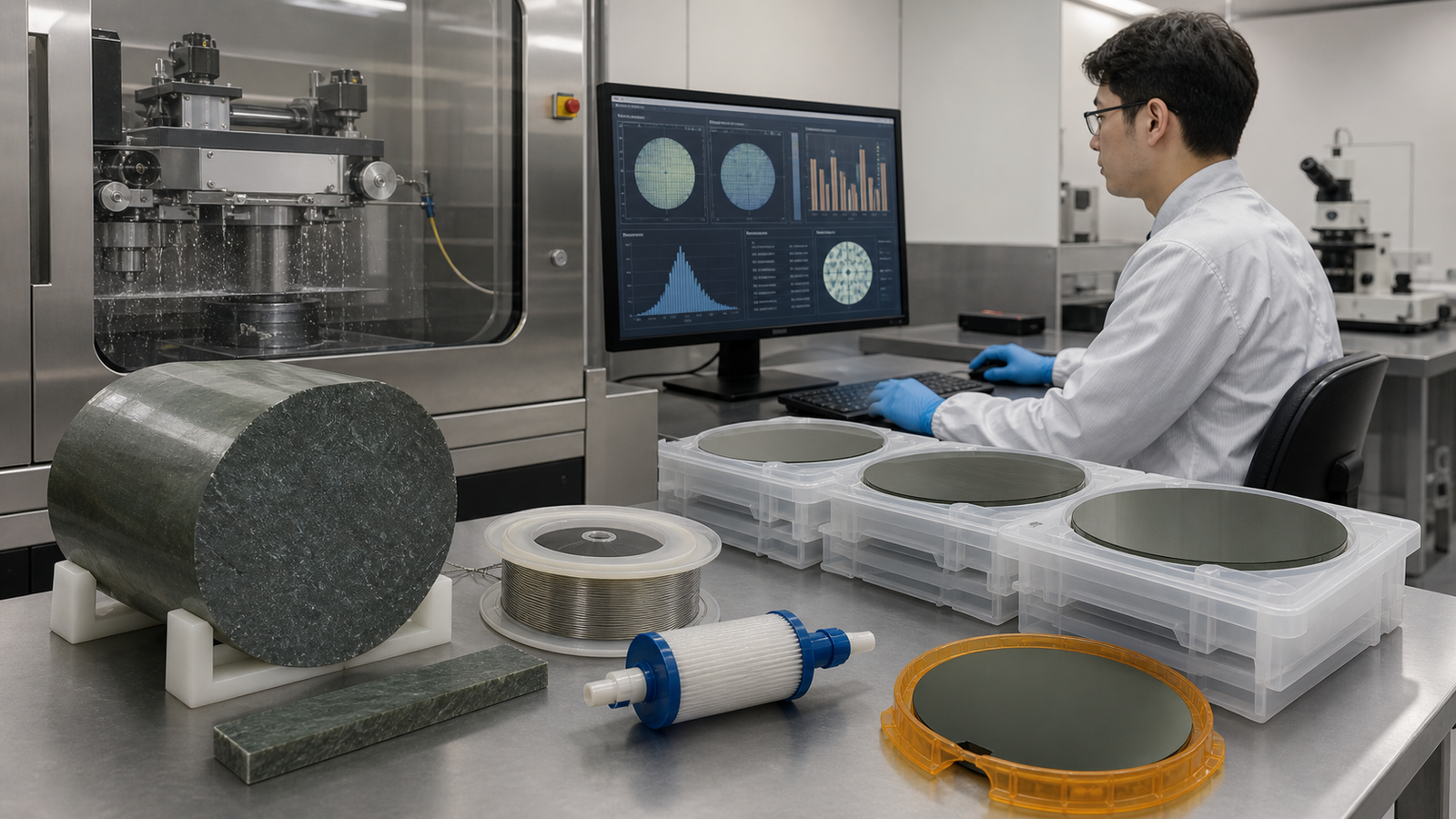
Build a practical SiC slicing cost model using kerf loss, yield, wire life, cycle time, finishing allowance and diamond wire saw data.

Learn how 200 mm SiC wafer slicing changes contact length, wire bow, coolant delivery, TTV control and diamond wire saw qualification.

ewirexon.com
Normalmente responde en cuestión de minutos
Hola, ¿puedo ayudarte en algo?
Envíanos un mensaje por WhatsApp
🟢En línea | Política de privacidad
Envíanos un mensaje por WhatsApp