









Aluminum nitride is selected for applications where electrical insulation and heat removal must coexist: power-module substrates, RF components, LED packages, heat spreaders and emerging semiconductor structures. That value also makes cutting loss expensive. A plate that leaves the saw with hidden microcracks, orientation error or excess stock allowance may not fail until grinding, metallization, thermal cycling or assembly.
A 2026 study in हीरा और संबंधित पदार्थ adds an important warning for AlN substrate cutting. Under the researchers’ machine and test conditions, wire-winding frequency above 40 Hz produced instability, worse surface quality and measurable lattice-plane tilting. The result is useful, but 40 Hz is not a universal machine limit. Guide spacing, wire path, tension, diameter, abrasive distribution, workpiece geometry and sensor definition all change the vibration response.
The production lesson is more valuable than the number: a हीरे की तार वाली आरी should be qualified as a dynamic cutting system. Speed and feed commands are inputs; wire motion, cutting load, surface integrity and accepted-part yield are the outputs.
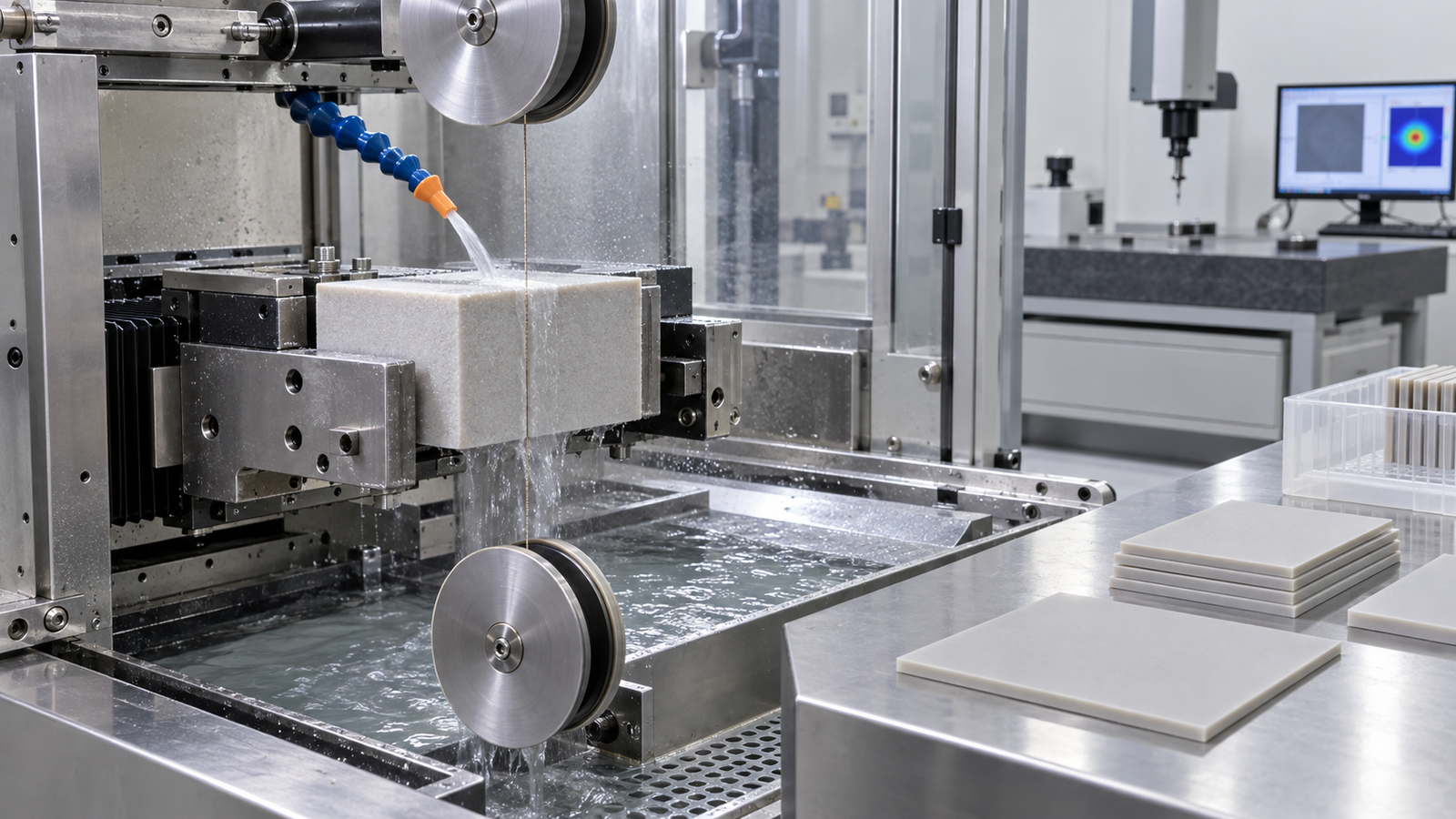
Why AlN matters in high-power and AI-era electronics
Modern power conversion and computing place more heat into smaller assemblies. AlN is attractive because it can combine useful thermal conductivity with electrical insulation and a coefficient of thermal expansion that is compatible with several semiconductor and packaging structures. Recent research continues to target higher-conductivity AlN ceramics and low-temperature AlN integration for advanced thermal management.
However, the label “AlN substrate” covers different materials. Sintered AlN ceramic contains grains, grain boundaries, additives and residual porosity. Single-crystal AlN has a crystallographic orientation and no ceramic grain-boundary network. A reaction-bonded or composite grade may behave differently again. Their crack paths, abrasive wear and coolant interactions are not interchangeable. Every RFQ and trial record should identify:
- material route and grade, not only nominal AlN percentage;
- single-crystal orientation or ceramic microstructure where relevant;
- density, porosity and secondary phases;
- blank dimensions and whether the surface is fired, ground or metallized;
- target thickness, finishing allowance and final strength requirement.
This distinction prevents a recipe developed on a dense ceramic coupon from being presented as proof for a crystalline wafer or a porous production blank.
Why AlN is difficult to cut without hidden damage
AlN is hard and brittle. Fixed diamond grains remove it through scratching, ploughing, microfracture and chip formation. Productive cutting occurs when grains penetrate enough to remove controlled fragments while the wire path remains stable. Too little effective penetration increases rubbing and heat; too much local penetration promotes deep cracks, grain pull-out and edge chipping.
Four mechanisms interact:
- Brittle fracture: cracks can extend below a surface that looks acceptable under low magnification.
- Dynamic wire motion: transverse vibration changes instantaneous grain depth and can leave periodic marks.
- Abrasive condition: blunting, fracture and pull-out change cutting ability during the wire’s life.
- Debris recutting: insufficient coolant access allows hard AlN particles to load the kerf and scratch the part again.
A narrow kerf is therefore not sufficient evidence of a good process. Material saved at the saw can be lost later as extra grinding allowance or rejected parts.
How wire vibration changes AlN surface integrity
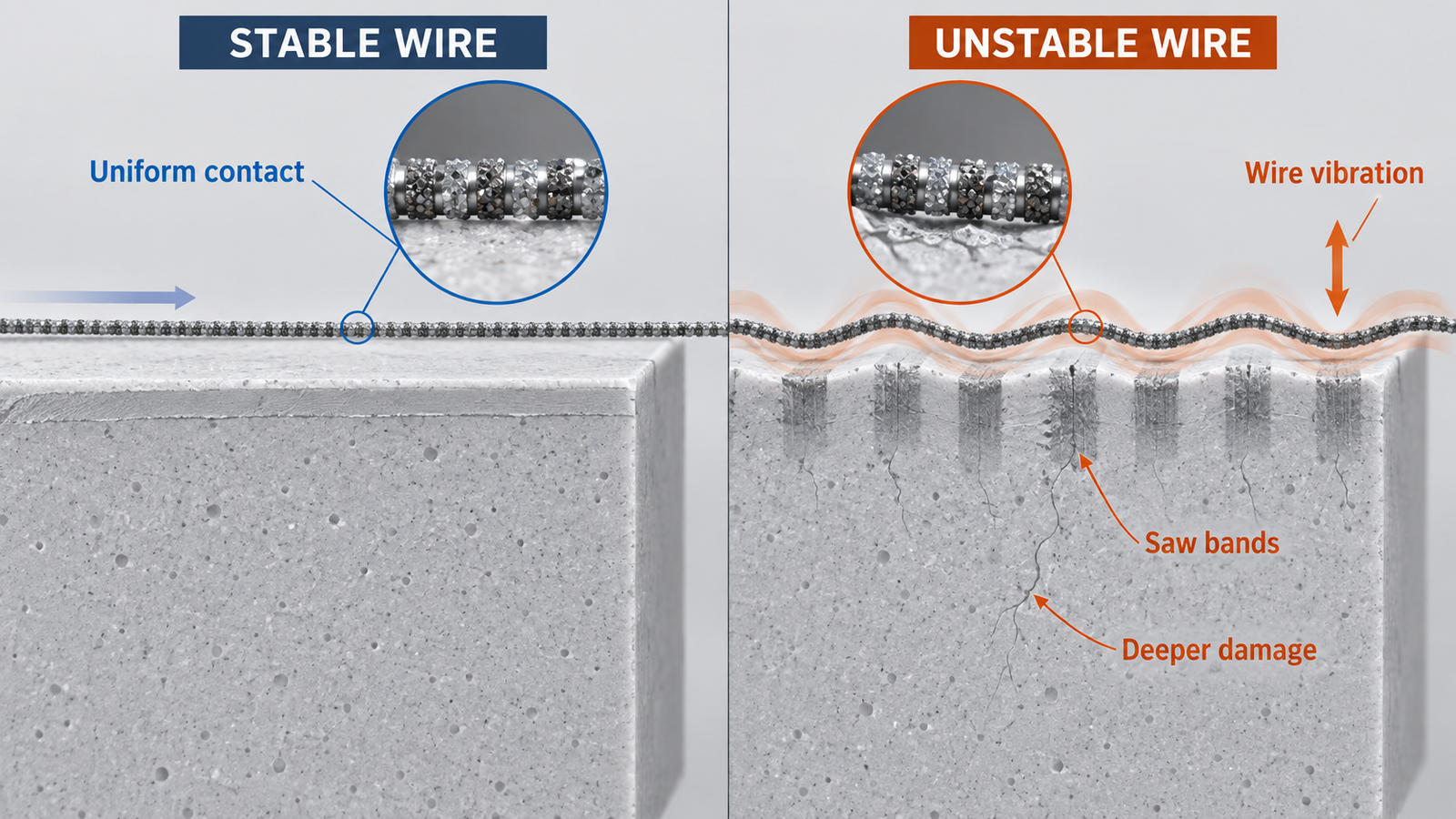
The wire is tensioned but flexible. Drive rotation, guide-wheel runout, wire joints or coating variation, workpiece force and fluid excitation can all introduce periodic motion. When an excitation approaches a responsive mode of the wire path, amplitude can rise even if the commanded speed remains constant.
At the abrasive scale, vibration changes the contact from one grain pass to the next. A grain may briefly cut deeper, lose contact or strike the surface at a different angle. The visible result may be regular bands, roughness variation or local pits. Below the surface, the result can include a thicker damaged layer, microcrack clusters or lattice disturbance.
The 2026 AlN study reported that higher-frequency conditions in its setup produced lattice-plane tilting and macroscopic orientation deviation confirmed by X-ray diffraction. This matters for crystalline substrates because a dimensional pass does not guarantee crystallographic alignment. It also matters for ceramic parts: although XRD interpretation differs, dynamic load can still change fracture and grain pull-out.
Why a frequency threshold cannot be copied
Frequency labels are meaningful only with a defined measurement point and machine configuration. One supplier may report motor rotation frequency, another guide-wheel rotation, wire reciprocation, control-command frequency or measured vibration peak. Before comparing values, document what was measured, where the sensor was mounted, the sampling rate and whether the value is a fundamental or harmonic.
A better acceptance rule combines vibration amplitude or spectral change with cutting-load and part-quality outputs. The machine should not be rejected because one frequency appears in a paper; it should be qualified against the target material and geometry.
Damage signatures and what they usually indicate
| Observed signature | Likely mechanisms to investigate | First checks |
|---|---|---|
| Periodic saw bands | Wire or wheel excitation, feed pulsation, runout | Spectral peak, guide condition, mark spacing versus wire speed |
| Random deep pits | Abrasive pull-out, large grains, debris recutting, ceramic grain pull-out | Wire microscopy, coolant solids, material microstructure |
| Entry or exit chipping | Unsupported edge, high local feed, fixture or bond-line compliance | Support geometry, feed profile, edge orientation |
| Rising roughness through a batch | Wire blunting, loading, coolant deterioration | Wire-life position, power, flow and filter differential |
| Waviness with acceptable Ra | Low-frequency bow or lateral path movement | Long-profile scan, tension response, contact-length stage |
| Orientation drift on crystal AlN | Asymmetric force, dynamic wire motion, mounting error | XRD map, crystal datum, feed direction, fixture alignment |
Do not diagnose from appearance alone. Periodic marks can share a spacing while having different causes. Correlate surface position with time-series data and preserve the direction of wire travel in the metrology record.
Build a measurement stack for a precision diamond wire saw
No single sensor proves process stability. A useful stack combines machine, wire, fluid and part measurements:
- Drive power or motor current tracks total resistance after idle losses are removed.
- Tension response and wire bow show how cutting load changes through the workpiece.
- Accelerometer or acoustic-emission data identify changing dynamic content when properly sampled and mounted.
- Coolant flow, temperature and filter differential document the debris-removal environment.
- Surface profiles separate roughness, waviness and global shape.
- Microscopy and selected cross-sections reveal pits, cracks and subsurface damage.
- XRD mapping is valuable for crystalline material when orientation retention matters.
Synchronize data clocks. A vibration peak is far more useful when it can be tied to maximum contact length, a surface band or an edge event. The broader surface-quality feedback guide explains how to return metrology findings to the recipe.
Process controls for lower-damage AlN substrate cutting
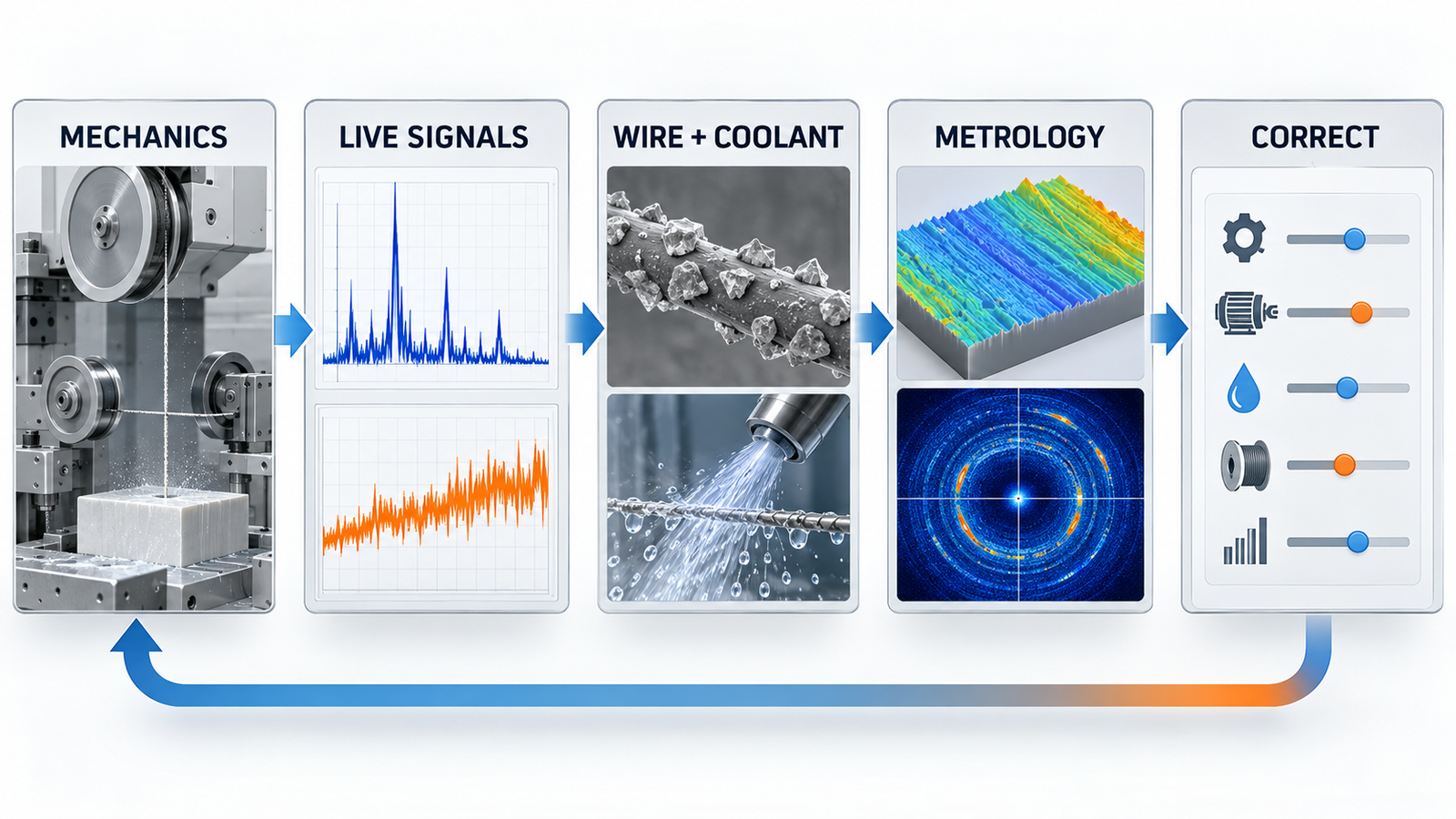
Stabilize the wire path before increasing feed
Verify guide-wheel runout, groove condition, alignment, free span and fixture rigidity. A high feed rate can hide poor cutting ability by forcing the wire into a larger bow. If vibration or power rises disproportionately, correct the mechanical condition before using tension as a cure.
Tune wire speed, feed and tension together
Higher wire speed increases abrasive engagements and can improve debris transport, but it also changes excitation frequency and sliding distance. Higher feed increases removal demand and grain penetration. Higher tension can reduce deflection while raising wire and guide load. A stable window is found with a designed experiment, not one-factor maximums. The existing wire speed and feed guide provides a suitable structure.
Control abrasive specification and wire life
Wire diameter, grit size, protrusion, density and bond retention influence both cutting capacity and damage depth. Qualify new, conditioned and aged wire separately. If vibration increases as the wire dulls, the root cause may be greater force rather than a drive-system change. Use the wire replacement-window method to combine microscopy, load and part quality.
Support the exit edge
Edge chipping often becomes severe when the final ligament is thin. Use a compatible sacrificial support or bond layer, verify adhesive stiffness and reduce feed in the exit zone when trials justify it. Record support thickness and curing method as process parameters.
Deliver coolant into the active kerf
Measure flow rather than relying on a pump setting. Inspect nozzle position, wetting, filtration and solids loading. For dense AlN powder, fluid can appear clear while fine particles remain active. The coolant and debris-removal guide covers practical checks.
Endless diamond wire saw versus diamond multi-wire saw
एक अनंत हीरे की तार वाली आरी is useful for R&D, orientation studies, special shapes, small batches and controlled vibration experiments. The same loop repeatedly crosses the cut, allowing engineers to characterize a defined wire population and change one factor at a time.
A diamond multi-wire saw is appropriate when many parallel plates or wafers must be produced in one cycle. It introduces web-level variables: pitch, lane tension, guide-groove consistency, coolant distribution and position-dependent wire age. A single-wire recipe is a starting point, not proof of multi-wire capability. Preserve each part’s lane position during qualification.
A desktop endless-loop system can screen coupons and material grades efficiently, but coupon results must be reconfirmed at full contact length and production fixture stiffness.
A practical AlN qualification plan
- Define material and output. Record grade, process route, microstructure or orientation, blank condition, target thickness and final finishing route.
- Establish a mechanical baseline. Measure guide runout, alignment, free vibration, tension repeatability and coolant delivery before cutting expensive material.
- Run a conservative reference cut. Log power, tension, vibration and contact stage with a conditioned wire.
- Map the part. Measure roughness, waviness, edge chips and thickness at entry, center and exit. Add XRD or subsurface-damage sampling where required.
- Screen coupled parameters. Change speed, feed and tension in a bounded DOE while holding wire age and fluid condition constant.
- Challenge repeatability. Repeat across material lots, wire life, operators, filters and planned stops.
- Validate downstream yield. Finish representative parts and calculate stock removal and accepted-part cost.
Procurement questions for AlN cutting equipment
- Which AlN grade and geometry have been demonstrated, and was it ceramic or single crystal?
- How are actual wire tension, bow, drive load and vibration monitored or exported?
- What guide-wheel and free-span configuration was used for the reference result?
- How are surface damage, waviness, edge chips and subsurface cracks measured?
- Can the factory acceptance test include conditioned and aged wire?
- How are coolant flow, filtration and contamination controlled?
- What application support is included for fixture, wire and recipe development?
How ewirexon supports AlN cutting applications
Ewirexon provides endless diamond wire saw, diamond multi-wire saw and desktop systems for hard brittle material cutting, along with wire consumables, fixtures and process support. For AlN projects, the useful starting point is the actual grade, dimensions, cut orientation, target finish and throughput rather than a generic material name.
The company’s AlN सब्सट्रेट स्लाइसिंग अनुप्रयोग, process-parameter consulting and customized equipment development can be evaluated against a documented trial and acceptance plan. Performance targets should remain trial targets until demonstrated on the customer’s material.
निष्कर्ष
Wire vibration is not a secondary machine-detail problem in AlN substrate cutting. It changes instantaneous abrasive contact and can affect roughness, waviness, chipping, subsurface damage and, for crystalline material, orientation. The newest research strengthens the case for measuring dynamic behavior, but its frequency threshold should not be copied without the same machine and measurement definition.
A reliable precision diamond wire saw process links speed, feed, tension, wire condition and coolant to synchronized machine signals and spatial part metrology. That approach gives engineers a stable process window and gives purchasing teams evidence based on accepted components rather than an attractive demonstration cut.
Frequently asked questions
What is the best way to cut an AlN substrate?
For slicing and blank preparation, a fixed-abrasive diamond wire saw can provide narrow kerf and relatively low cutting force. The exact method depends on AlN grade, geometry, finishing allowance, throughput and damage limit.
Does the 40 Hz result mean every AlN saw must run below 40 Hz?
No. It was a threshold observed in one 2026 study under defined conditions. Different wire paths, guide wheels, spans and measurement definitions have different dynamic responses. Qualify amplitude and part quality on the target machine.
How can wire vibration be detected?
Combine accelerometer or acoustic-emission spectra with tension, bow, drive power and surface-mark spacing. A frequency peak alone is not enough; it must correlate with cutting stage and part quality.
Can the same recipe cut ceramic and single-crystal AlN?
It should not be assumed. Ceramic grain boundaries, porosity and additives create different fracture behavior from single-crystal orientation. Use the previous recipe only as a bounded starting point.
When should an endless saw be replaced by a diamond multi-wire saw?
Use endless-wire trials to understand material response and special-part requirements. Move to multi-wire qualification when parallel throughput is needed, then verify pitch, lane tension, cooling and wire-web consistency.
तकनीकी संदर्भ
- एल्यूमिनियम नाइट्राइड की हीरे की तार कटाई में सतही क्षति तंत्र और प्रक्रिया नियंत्रण.
- High-speed, high-thermal-conductivity aluminum nitride deposited at low temperature.
- Thermally conductive buried aluminum nitride for next-generation silicon-on-insulator.
Editorial note: Study-specific thresholds and mechanisms are attributed to their sources and are not presented as universal machine specifications. The figures are AI-generated engineering illustrations, not customer installations or measured production data.