
Stacking several ceramic plates for one cut looks like an obvious productivity gain. Loading time falls and one wire pass creates multiple parts. In practice, every added interface changes stiffness, coolant access, debris escape and load distribution. A stack can improve throughput or turn one defect into a batch of rejects.
Advanced ceramics include alumina, aluminum nitride, silicon nitride, zirconia-toughened alumina and many custom composites. Their hardness, toughness, porosity and thermal conductivity differ. A recipe that works for dense alumina tiles may chip an AlN substrate or trap debris between porous ceramic plates.
A elmas tel testere provides low-force, narrow-kerf cutting for hard brittle materials. Stack cutting is an application strategy, not an automatic machine feature. This guide shows how to decide when it is justified and how to qualify it using accepted parts per hour rather than parts nominally separated.
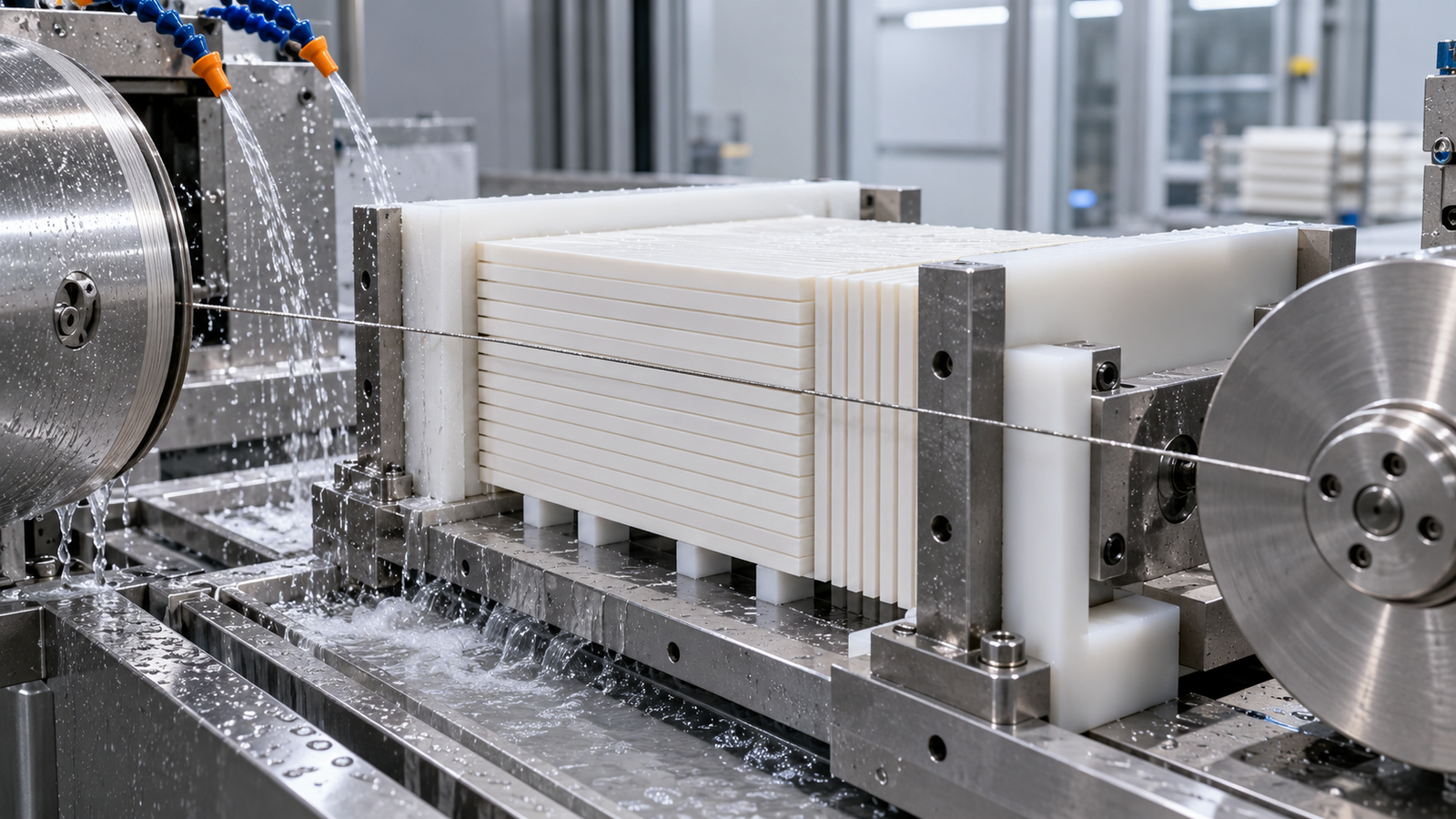
Why stack cutting changes the mechanics
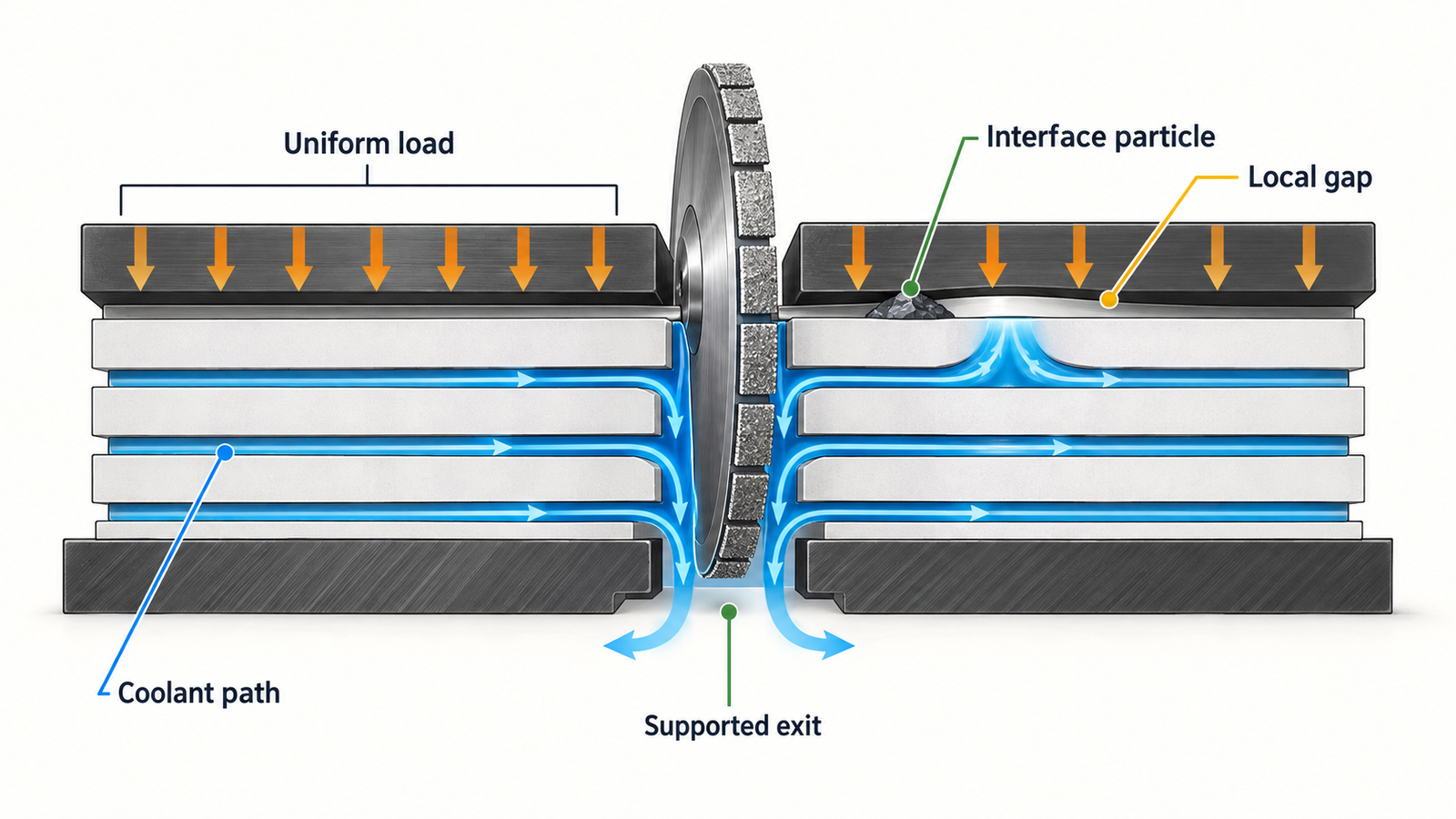
In a single plate, the fixture supports one workpiece and coolant has direct access to the kerf. In a stack, clamp load passes through multiple surfaces. Thickness variation, dust or flatness error creates hard contact points and gaps. Some plates carry more load, while others can vibrate or slide.
The wire also crosses repeated entry and exit edges. Each interface is a chance for chipping and a disturbance in removal load. If plates are bonded, the adhesive layer changes stiffness and can load the wire. If they are only clamped, relative motion can mark faces or alter kerf position.
Stack height increases total contact length when plates align in the feed direction. Removal force and wire bow can rise. A machine that cuts one part accurately may not have sufficient tension, stiffness, coolant or debris capacity for a tall stack.
Start by grouping ceramics correctly
Do not mix materials in one stack merely because their dimensions match. Record ceramic composition, grade, density, grain size, sintering route, porosity, surface finish and prior stress history. Co-fired metallization, braze, coatings or green-state layers add further interfaces.
Examples of process differences:
- Alumina is hard and brittle, with behavior changing by purity and grain structure.
- Aluminum nitride has high thermal conductivity but can be sensitive to moisture and edge damage depending on grade.
- Silicon nitride has greater fracture toughness than many oxide ceramics but remains difficult to machine.
- Zirconia-containing materials can show different transformation and crack responses.
- Porous ceramics trap fluid and debris and may require a controlled drying process.
Qualify one defined material family at a time. A generic “ceramic stack” acceptance test is not transferable.
Clamped, bonded or carrier-supported stacks
Mechanically clamped
Clamping enables quick loading and avoids adhesive residue. It requires flat, clean interfaces and a controlled force distribution. Point loading can crack the top plate while insufficient force allows slip. Use compliant layers only after confirming they do not trap abrasive or alter alignment.
Temporarily bonded
Bonding can make the stack act more like one body and support exit edges. Adhesive thickness variation creates pitch error, and the adhesive may soften, swell or load the wire. Cure, removal and cleaning become part of the process. Test chemical compatibility with AlN and any metallization.
Carrier-supported
A carrier or pocket fixture can locate each plate and provide an exit backing. It adds setup complexity but improves repeatability for recurring products. Design coolant access and debris escape into the fixture. Blind pockets can become particle reservoirs.
Whichever approach is used, measure stack compression and part position. Fixture force should be specified and repeatable, not described as “hand tight.”
Control edge chips at every interface
Each plate has an entry and exit edge. A ten-plate stack creates many transitions, even if the cut looks continuous from outside. Mark each plate’s order and orientation, then map chips by interface. If middle plates perform worse, debris and coolant transport may be inadequate. If top and bottom plates fail, clamp or backing conditions may dominate.
Reduce feed near the first entry, internal transitions where needed, and final exit. A programmable profile is more useful than one slow global feed. Wire speed and tension should remain in the qualified range while feed controls grain load.
Support the final ligament so it cannot tear from the stack. If parts are bonded, inspect after debonding because cracks can remain hidden at the interfaces during the initial check.
Coolant and debris limit practical stack height
A taller contact zone makes it harder for fresh coolant to reach every cutting point and for ceramic debris to leave. Recirculated particles scratch faces and raise force. Pump flow does not prove internal flushing.
During development, use transparent surrogate fixtures or collection tests where possible to understand flow. Record manifold pressure, coolant temperature, filter differential pressure and solids. Inspect each plate for a depth-related surface trend. If inner plates show more marks, reduce stack height, improve flow access or change spacer and fixture geometry.
For porous ceramics, include fluid uptake and drying. Trapped moisture can affect mass, electrical testing, bonding or later thermal cycles. Define a drying endpoint instead of a fixed time alone.
Wire selection for batch ceramic cutting
A fine wire lowers kerf, but a stack increases contact and load. The optimum wire may differ from a single-plate process. Compare diameter, abrasive size and bond using total stack yield. Monitor bow, drive load, cut time, wire wear and particles.
Harder ceramics need sufficient abrasive protrusion and chip space. If the wire loads, slowing feed may not restore a clean cut. The wire selection framework can structure a trial without changing several variables at once.
A go/no-go qualification for stack cutting
- Baseline one plate. Establish force, kerf, surface, chips, cycle time and accepted yield.
- Add plates gradually. Test two, then a moderate stack; do not jump directly to maximum fixture height.
- Control interface preparation. Define cleaning, flatness, adhesive or spacer thickness and clamp force.
- Map every position. Keep plate order, orientation, cut direction and wire-life stage.
- Measure geometry and damage. Include thickness, parallelism, edge chips, roughness, waviness and sampled subsurface damage.
- Complete release and cleaning. Count cracks and breakage after debonding, washing and drying.
- Repeat over normal production. Include fixture changes, operators and later wire life.
- Calculate accepted throughput. Include loading, curing, debonding, cleaning and rejected parts.
Set a maximum qualified stack height by material and thickness. A fixture’s physical capacity is not the process limit.
When multi-wire cutting is the better batch method
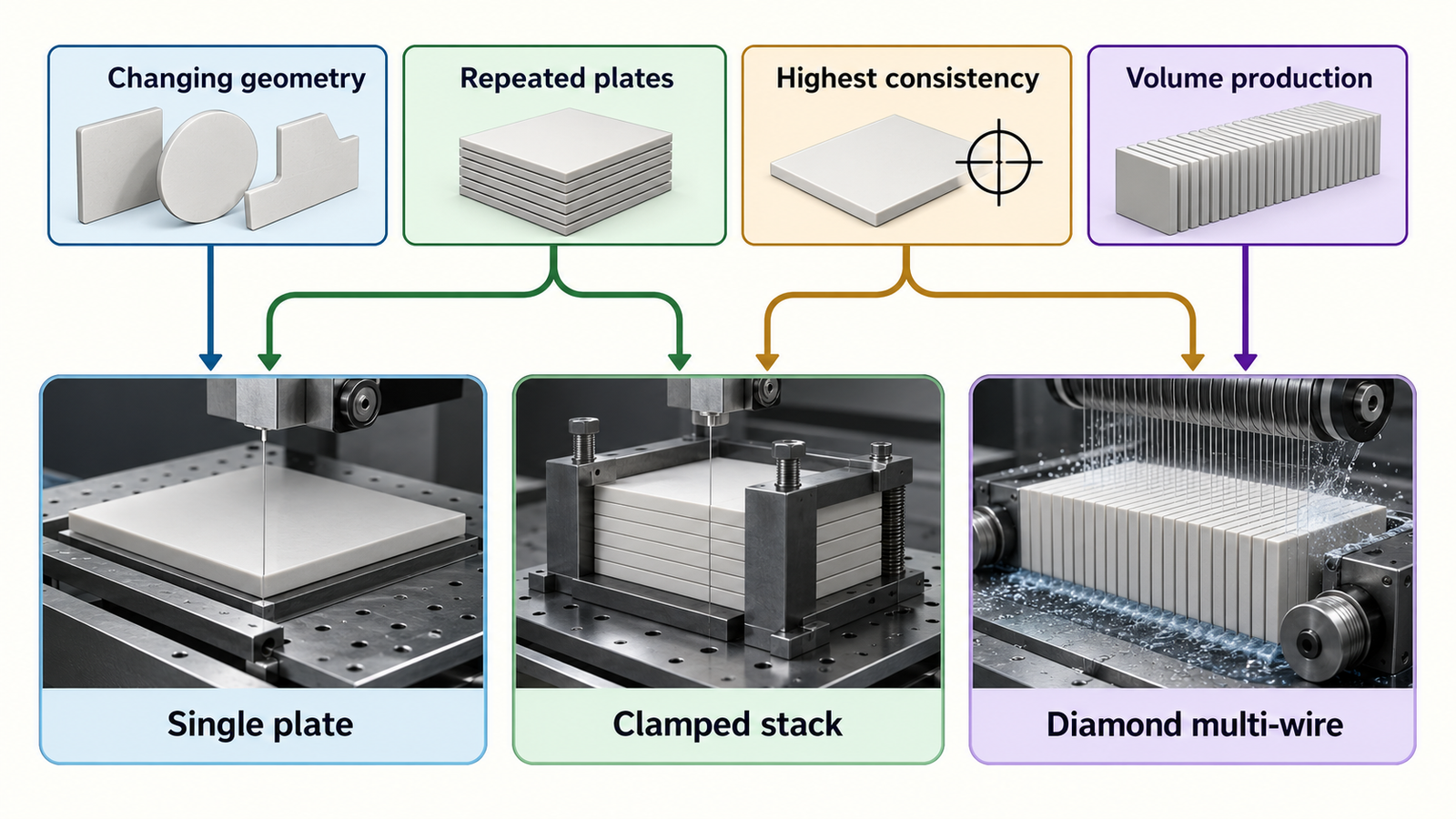
Stack cutting with an endless diamond wire saw increases parts along the clamping direction. A diamond multi-wire saw creates several parallel cuts through one workpiece or stack. If the product requires many repeated slices, multi-wire architecture may provide better pitch control and throughput.
The multi-wire option adds lane uniformity, guide-groove and unloading requirements. Compare it against a stacked endless process using accepted parts, not cuts per cycle. For special profiles, changing dimensions or R&D lots, the endless wire approach for high-hardness ceramic components may remain more flexible.
Production and procurement metrics
| Metric | Decision value |
|---|---|
| Accepted parts per loaded stack | Shows defect multiplication |
| Accepted parts per hour | Includes load, bond, cut, release and clean time |
| Chip map by stack position | Reveals support and coolant limits |
| Thickness/parallelism by position | Shows clamp and adhesive effects |
| Wire use per accepted area | Captures higher contact and wear |
| Breakage and rework cost | Prevents nominal throughput from hiding loss |
How ewirexon supports ceramic cutting trials
Ewirexon develops endless and diamond multi-wire saw equipment for advanced ceramic cutting, including alumina, AlN and other hard brittle components. Project inputs should include exact grade, plate dimensions, coatings or metallization, edge and surface limits, cleaning restrictions, annual mix and desired batch size.
A sample trial can establish the single-part baseline and then increase stack height under controlled conditions. When recurring geometry justifies a dedicated carrier, fixture customization should be tied to clamp-force repeatability, coolant access and safe unloading.
Sonuç
Stack cutting can raise advanced-ceramic throughput, but it multiplies interfaces and couples the fate of several parts. The practical limit is set by load distribution, coolant and debris transport, wire stability and post-cut handling, not the available fixture height.
Increase stack height step by step and map every plate. Use accepted parts per hour after release and cleaning as the decision metric. That disciplined approach reveals when batching is a genuine productivity improvement and when a multi-wire or single-part process is more reliable.
Sıkça sorulan sorular
Can advanced ceramics be stack cut with a diamond wire saw?
Yes, when plates are compatible and the fixture, coolant and wire can support the combined contact. Maximum stack height must be qualified for each material and thickness.
Should ceramic plates be clamped or bonded?
Clamping simplifies release but needs uniform force and flat interfaces. Bonding improves support but adds adhesive thickness, chemistry and cleaning risks.
Why do middle plates in a stack show more damage?
Coolant and debris transport may be weaker inside the stack. Interface movement or trapped particles can also increase marks and chips.
Does stack cutting reduce kerf?
It can improve loading efficiency and throughput, but kerf per cut is mainly governed by wire and motion. Total material yield also depends on chips and finishing.
When is a diamond multi-wire saw better for ceramics?
It can be better for repeated parallel slices at production volume. An endless system is often more flexible for special shapes, changing sizes and process development.
Teknik kaynaklar
- Diamond-wire-saw processing of zirconia-toughened alumina ceramic, 2025.
- Processing behavior of silicon nitride ceramic under diamond wire cutting.
- Experimental study of diamond wire sawing for silicon nitride ceramics.
Editorial note: Stack limits and coolant compatibility are material- and geometry-specific. The figures are AI-generated engineering illustrations, not customer fixtures or certified process drawings.