









Silicon carbide, usually written as SiC, has become one of the most important materials in power electronics, electric vehicles, renewable energy systems, RF devices and high-temperature semiconductor applications. As the industry moves toward larger wafer formats and tighter cost control, manufacturers are under growing pressure to improve wafer yield, reduce slicing waste and stabilize production cost.
One of the most practical ways to improve SiC wafer manufacturing economics is Reduzierung des Schnittverlusts.
Kerf loss is the material removed by the cutting tool during slicing. In SiC wafer cutting, this lost material is not a small detail. SiC crystals are expensive to grow, slow to process and difficult to machine. Every micron of unnecessary kerf width means more material turns into cutting debris instead of saleable wafers.
For semiconductor factories, process engineers and procurement managers, reducing kerf loss is not only a technical goal. It affects cost per wafer, throughput, surface quality, downstream grinding and polishing time, and long-term production stability.
Why SiC Is So Difficult to Cut
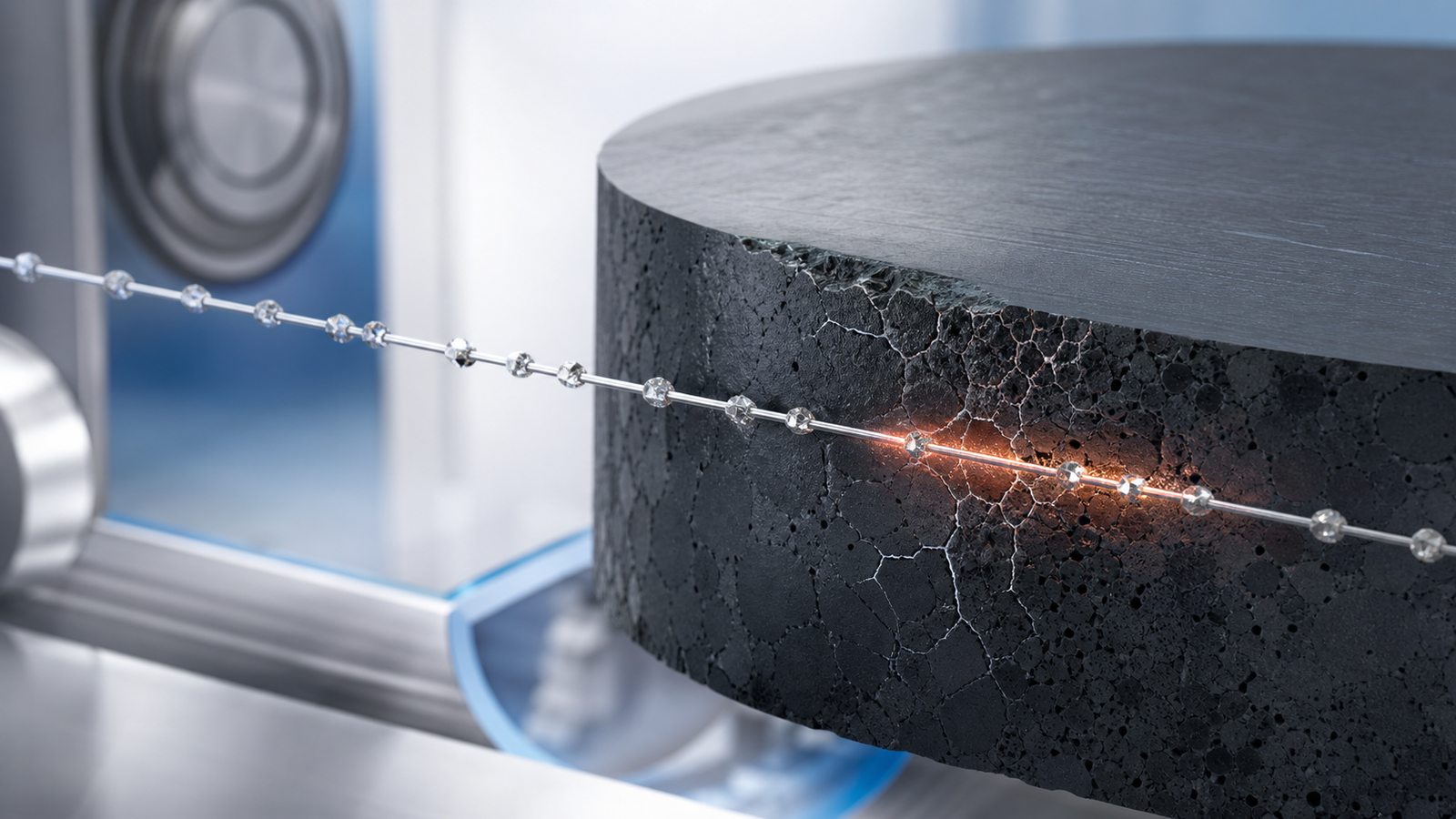
SiC is a hard brittle material. That phrase sounds simple, but it explains most of the challenges in wafer slicing.
First, SiC has very high hardness. Conventional cutting tools wear quickly when processing it. A tool that works well on softer materials may generate excessive heat, lose sharpness or create unstable cutting forces when applied to SiC.
Second, SiC has low fracture toughness compared with ductile metals. Instead of deforming smoothly under stress, it tends to crack. During slicing, local stress from abrasive grains can create micro-cracks, edge chipping and subsurface damage. These defects may not always be visible immediately, but they can increase material removal in later lapping or polishing steps.
Third, SiC has high thermal conductivity and strong chemical stability. These properties are excellent for power devices, but they make machining more demanding. Heat must be controlled, coolant flow must be stable and abrasive contact must remain consistent.
Fourth, SiC wafer quality requirements are strict. Power semiconductor manufacturers need wafers with controlled thickness variation, low warp, low bow, limited subsurface damage and stable surface condition for downstream epitaxy and device fabrication.
This is why SiC wafer cutting is not simply sawing an ingot. It is a controlled material removal process where wire diameter, diamond grit, wire tension, feed rate, coolant delivery, machine rigidity, vibration and process monitoring all matter. Ewirexon discusses this application area in its SiC and compound semiconductor cutting solution, where the focus is stable low-damage slicing for wide-bandgap materials.
Why Kerf Loss Matters in SiC Wafer Cutting
Kerf loss is the width of material removed by the cutting process. In wafer slicing, the removed material becomes powder, slurry or debris. It cannot become a finished wafer.
For SiC, kerf loss is especially important because the raw crystal is costly. Crystal growth is slow, equipment-intensive and quality-sensitive. If a factory can produce more wafers from the same ingot by reducing kerf width, the economic impact can be significant.
Kerf loss affects several areas:
- Material yield: A thinner cut means less SiC becomes waste.
- Wafer count per ingot: Lower kerf loss can increase the number of wafers obtained from a boule or ingot.
- Cost per wafer: More usable wafers from the same input material reduce the material cost allocated to each wafer.
- Downstream processing: Excessive cutting damage can require more grinding and polishing, which adds time and cost.
- Sustainability: Less cutting waste means better material utilization and lower process burden.
Procurement managers often compare equipment by purchase price, wire cost and throughput. Those are important, but for SiC, kerf loss should be part of the total cost calculation. A machine that delivers better yield and more stable slicing may reduce operating cost even if the initial specification looks similar to other systems.
How Diamond Wire Saw Technology Helps Reduce Kerf Loss
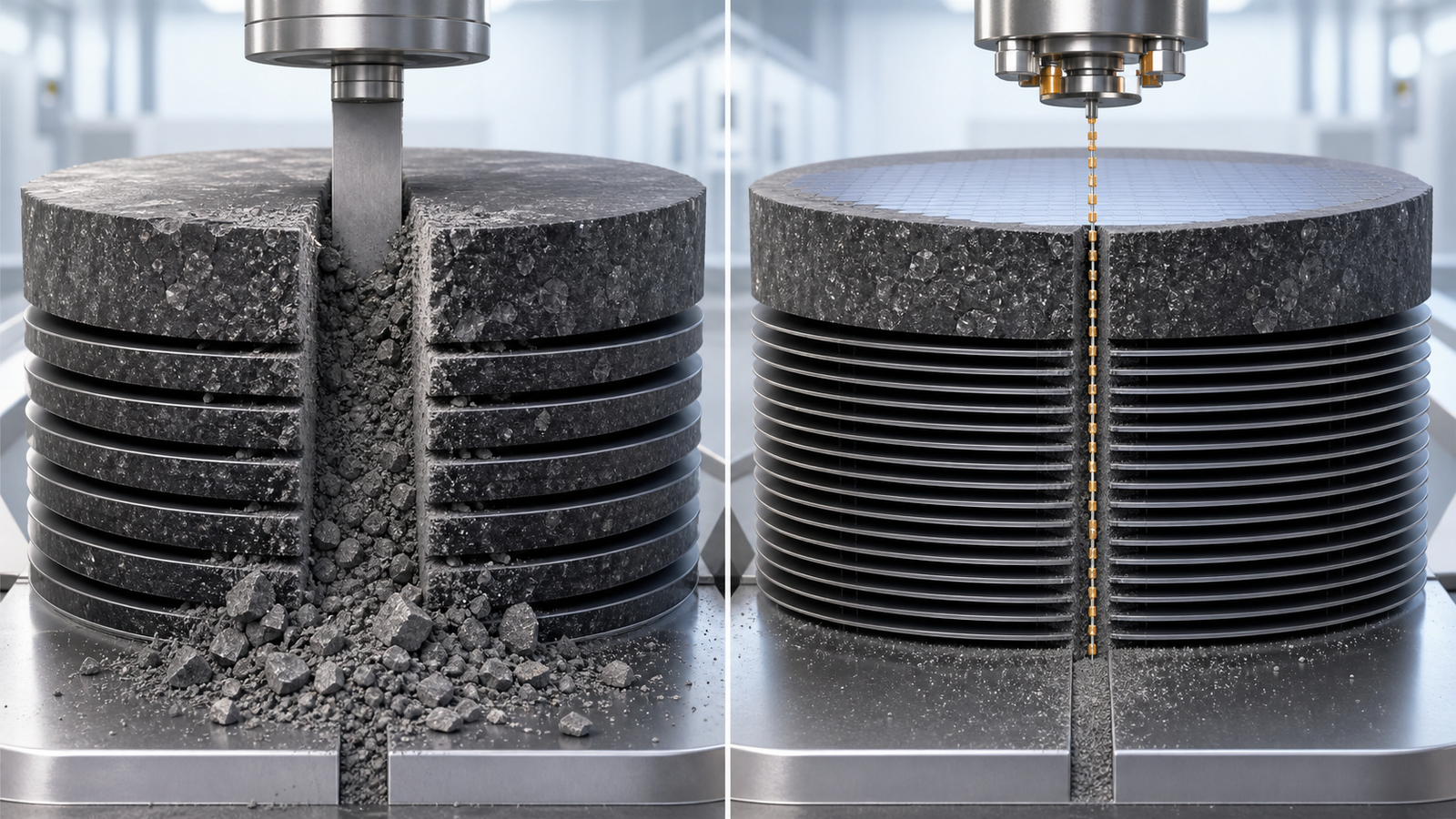
A Diamantdrahtsäge uses a thin wire with diamond abrasive particles to remove material. For SiC wafer cutting, diamond is the practical abrasive choice because SiC is extremely hard.
Compared with blade-based cutting or older slurry-based processes, fixed abrasive diamond wire cutting offers several advantages for Schneiden von hartem, sprödem Material.
The first advantage is a narrower cutting path. A fine diamond wire can create a smaller kerf than many blade processes. Less kerf means more wafer material is preserved.
The second advantage is lower cutting force when the process is optimized. Because many small diamond grains participate in material removal, the cutting action can be distributed more evenly. This helps reduce crack initiation and edge chipping.
The third advantage is better process control. Wire speed, tension, feed rate, coolant flow and wire path can be adjusted to match the SiC ingot size, crystal quality, wafer thickness target and surface damage limit.
The fourth advantage is scalability. For volume production, a diamond multi-wire saw can slice many wafers simultaneously, improving throughput while maintaining consistent spacing.
However, diamond wire saw technology is not automatically successful just because diamond is used. Poor parameter control can still cause wire bow, vibration, uneven kerf, wafer thickness variation and wire breakage. Kerf loss reduction depends on system design and process discipline.
Key Process Factors for Kerf Loss Reduction
1. Select the Right Wire Diameter
Wire diameter has a direct influence on kerf width. A thinner wire can reduce kerf loss, but it also requires better tension control and machine stability. If the wire is too thin for the load, it may deflect, vibrate or break.
The best wire choice balances kerf reduction with process reliability. For SiC, the goal is not simply to choose the thinnest possible wire. The goal is to choose the thinnest wire that can cut stably at the required feed rate, wafer thickness, ingot size and yield target.
2. Control Wire Tension
Wire tension affects cutting accuracy and wire bow. If tension is unstable, the wire path may shift during slicing. This can increase kerf variation, thickness variation and surface damage.
Stable tension is especially important in diamond multi-wire saw systems, where many parallel wires must maintain uniform cutting behavior across the ingot. Good tension control helps keep wafer spacing consistent and reduces the risk of local overload.
3. Optimize Feed Rate
A higher feed rate can improve throughput, but it also increases cutting force. In SiC wafer cutting, excessive feed may cause micro-cracks, rougher surfaces, wire wear or wire breakage.
A lower feed rate can improve surface quality, but it may reduce productivity and increase machine time. The practical solution is to define a process window: fast enough for production, slow enough to protect wafer quality.
4. Maintain Effective Coolant Flow
Coolant helps remove heat and debris from the cutting zone. In SiC cutting, coolant delivery is critical because debris accumulation can increase friction, widen the kerf and damage the wafer surface.
Coolant should reach the cutting interface consistently. Poor flow can create hot spots, uneven abrasive action and unstable cutting force. For multi-wire slicing, coolant distribution must be uniform across the entire wire web.
5. Reduce Vibration
Vibration is one of the hidden causes of kerf variation. Even if the wire diameter is small, machine vibration can cause the effective cutting path to become wider. This increases kerf loss and can worsen wafer quality.
A rigid machine structure, precision rollers, stable wire routing and balanced motion control all help reduce vibration. For SiC, small improvements in dynamic stability can lead to meaningful improvements in cutting quality.
6. Monitor Wire Wear
Diamond wire does not cut the same way throughout its life. As diamond grains wear, cutting force can rise and surface quality can change. If wire wear is ignored, the process may gradually drift outside the ideal kerf and damage window.
A practical production strategy should include wire life tracking, cutting force observation, surface inspection and scheduled replacement criteria.
7. Match Equipment Type to Production Goal
Not every SiC cutting task needs the same machine configuration.
For R&D, pilot production, small ingots, special shapes or high-value samples, an endless diamond wire saw can provide controlled, continuous cutting with stable wire motion and low-stress material removal.
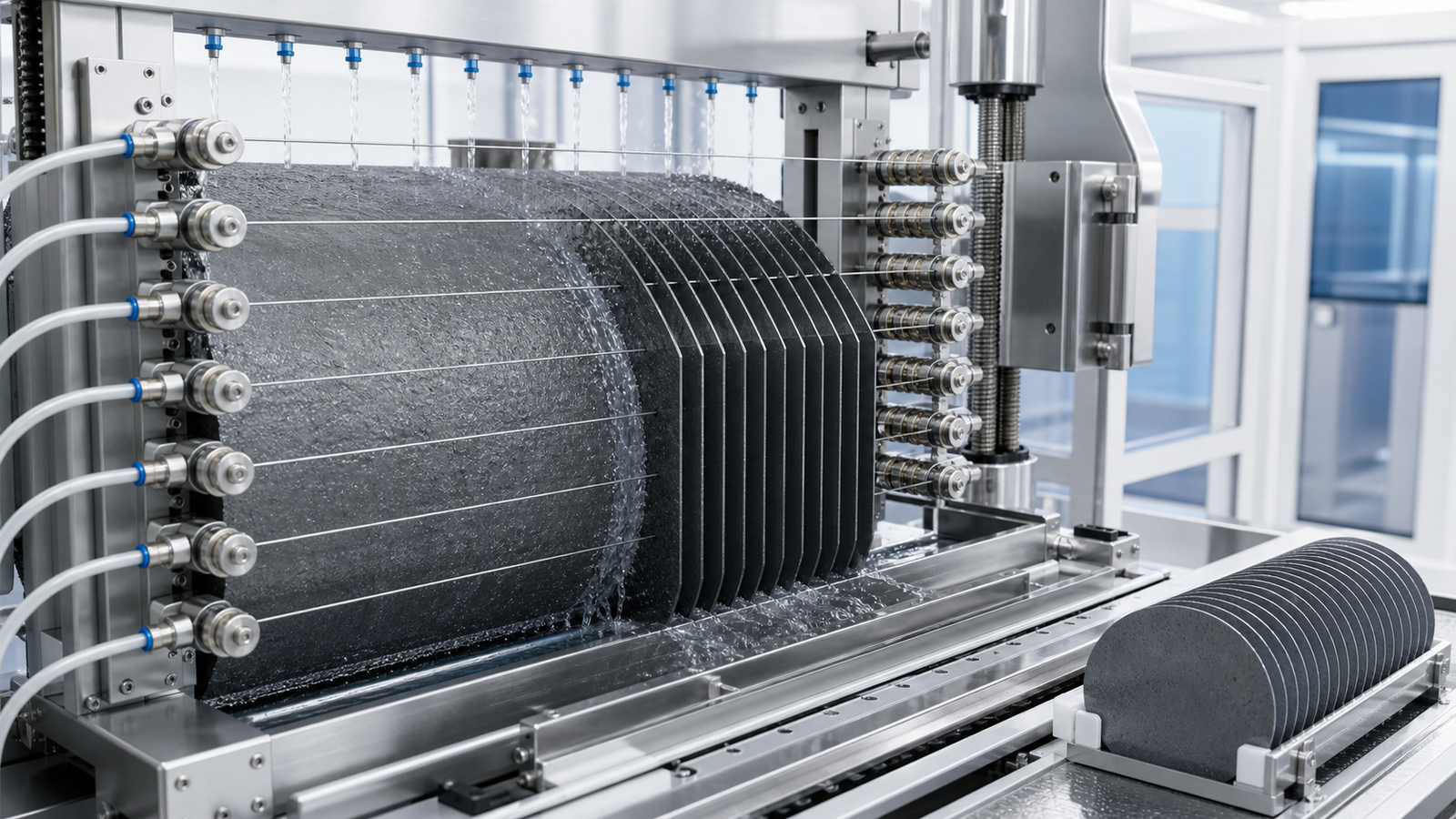
For high-volume wafer slicing, a diamond multi-wire saw is typically more suitable because it can cut many wafers in parallel. This improves productivity while supporting kerf loss reduction through fine wire spacing and controlled wire tension.
Ewirexon’s diamond wire saw product portfolio includes endless diamond wire saw systems and diamond multi-wire saw solutions for semiconductor substrates, SiC and compound semiconductor cutting, optical wafers, ceramics, sapphire, photovoltaic materials and other advanced hard brittle materials. In a SiC wafering project, these systems should be selected based on wafer diameter, ingot size, target thickness, required throughput, surface quality specification and factory automation needs.
Endless Diamond Wire Saw vs Diamond Multi-Wire Saw
An endless diamond wire saw uses a continuous loop of diamond wire. Because the wire moves in one continuous path, it can provide smooth cutting behavior and avoid some issues associated with reciprocating motion. It is useful for precision cutting, sample preparation, small-batch slicing, special material processing and applications where stable low-damage cutting is more important than maximum batch output.
A diamond multi-wire saw uses many parallel wires to slice multiple wafers at the same time. This is the preferred direction for industrial wafer production where throughput and wafer count are key. For SiC, the multi-wire process must be carefully engineered because the material is hard, brittle and expensive.
The choice between the two depends on the production goal. Use an endless diamond wire saw when flexibility, precision, low stress and process development are priorities. Use a diamond multi-wire saw when high-volume wafer slicing, parallel processing and production efficiency are priorities.
Many semiconductor manufacturers use both types at different stages: endless systems for process development, special cutting and engineering validation; multi-wire systems for scaled wafer slicing. For factories that also process silicon, sapphire, ceramics or optical substrates, related applications such as Schneiden von Siliziumwafern, Präzisionsbearbeitung optischer Wafer und electronic ceramic substrate cutting may require similar attention to low-damage cutting and material utilization.
Practical Checklist for Reducing Kerf Loss
For engineers working on SiC wafer cutting, the following checklist can help structure process improvement:
- Define the current kerf width and wafer yield baseline.
- Measure wafer thickness variation, surface roughness, edge chipping and subsurface damage.
- Review wire diameter, diamond grit size, wire wear and supplier consistency.
- Check wire tension stability during the full cutting cycle.
- Optimize feed rate and wire speed together, not separately.
- Inspect coolant flow uniformity across the cutting zone.
- Monitor cutting force, vibration, wire bow and wire breakage events.
- Compare wafer output per ingot before and after process changes.
- Include downstream grinding and polishing time in the evaluation.
For procurement managers, the evaluation should include more than machine price. Ask suppliers about process testing, sample cutting, wire compatibility, tension control, service support and parameter consulting. When the application is new or the material behavior is uncertain, process parameter consulting for diamond wire cutting can help shorten the path from trial cutting to a stable production recipe.
Industry Trend: Larger SiC Wafers Make Kerf Loss More Important
The SiC industry is moving toward larger wafer formats, especially 200 mm. Larger wafers can improve device output per wafer, but they also increase the difficulty of crystal growth, slicing, flatness control and defect management.
As wafer diameter increases, process stability becomes more critical. A small slicing problem can affect a larger material area and a higher-value wafer. This makes kerf loss reduction, wire stability and low-damage cutting even more important.
At the same time, market conditions are becoming more complex. Long-term SiC demand is supported by electric vehicles, renewable energy and industrial power electronics, while near-term capacity and pricing cycles require manufacturers to manage cost carefully. In both cases, lower cost per usable wafer is valuable.
That is why diamond wire saw optimization is not just a cutting-room issue. It is part of the broader SiC manufacturing cost roadmap.
Fazit
Reducing kerf loss in SiC wafer cutting requires more than choosing a thin wire. SiC is hard, brittle, valuable and sensitive to cutting damage. To improve yield, manufacturers need a stable diamond wire saw process that controls wire diameter, tension, feed rate, coolant delivery, vibration, wire wear and machine rigidity.
For low-volume precision cutting or process development, an endless diamond wire saw can provide stable, low-stress cutting for SiC and other hard brittle materials. For high-volume wafer production, a diamond multi-wire saw can improve throughput while supporting kerf loss reduction through parallel slicing and controlled wire spacing.
The best results come from matching the machine, wire, process parameters and wafer quality requirements as one system. For semiconductor factories, engineers and procurement teams, this approach turns kerf loss reduction into a measurable improvement in material yield, wafer cost and production reliability.
Häufig gestellte Fragen
What is kerf loss in SiC wafer cutting?
Kerf loss is the SiC material removed by the cutting tool during wafer slicing. It becomes cutting debris instead of a usable wafer. Lower kerf loss means better material utilization and more wafers from the same ingot.
Why is SiC harder to cut than silicon?
SiC is much harder and more brittle than conventional silicon. It resists material removal and can develop micro-cracks or subsurface damage if cutting force, vibration or heat is not controlled.
How does a diamond wire saw reduce kerf loss?
A diamond wire saw uses a thin wire with diamond abrasive particles. Compared with wider blade processes, it can create a narrower cutting path, reduce material waste and improve slicing precision when parameters are optimized.
Is thinner diamond wire always better?
No. A thinner wire can reduce kerf width, but it must remain stable under tension and cutting load. If the wire deflects, vibrates or breaks, wafer quality and yield may become worse.
What is the difference between an endless diamond wire saw and a diamond multi-wire saw?
An endless diamond wire saw uses a continuous loop of diamond wire and is useful for precision cutting, R&D, special shapes and low-stress processing. A diamond multi-wire saw uses many parallel wires to slice multiple wafers at once, making it suitable for higher-volume wafer production.
Which parameters matter most for kerf loss reduction?
Important parameters include wire diameter, wire tension, feed rate, wire speed, coolant flow, diamond grit condition, machine rigidity, vibration control and wire wear management.
Can diamond wire saws cut other hard brittle materials?
Yes. Diamond wire saw systems are widely used for hard brittle material cutting, including SiC, sapphire, quartz, optical glass, ceramics, graphite, compound semiconductor substrates and photovoltaic materials.