










Optical glass, quartz glass, quartz crystal, sapphire and infrared optical materials are becoming more important in photonics, semiconductor equipment, laser systems, optical communication, precision instruments and advanced sensing. These materials are chosen because they can provide transparency, thermal stability, chemical resistance and dimensional stability. The challenge is that the same materials are often hard, brittle and expensive to rework.
In optical glass cutting, the quality of the cut edge can influence almost everything that follows. Poor surface finish increases polishing time. Subsurface damage can reduce optical performance or create failure during coating. Edge chipping can lower yield before the part reaches its highest-value process step. This is why a Diamantdrahtsäge is often evaluated as a surface-quality tool, not only as a cutting machine.
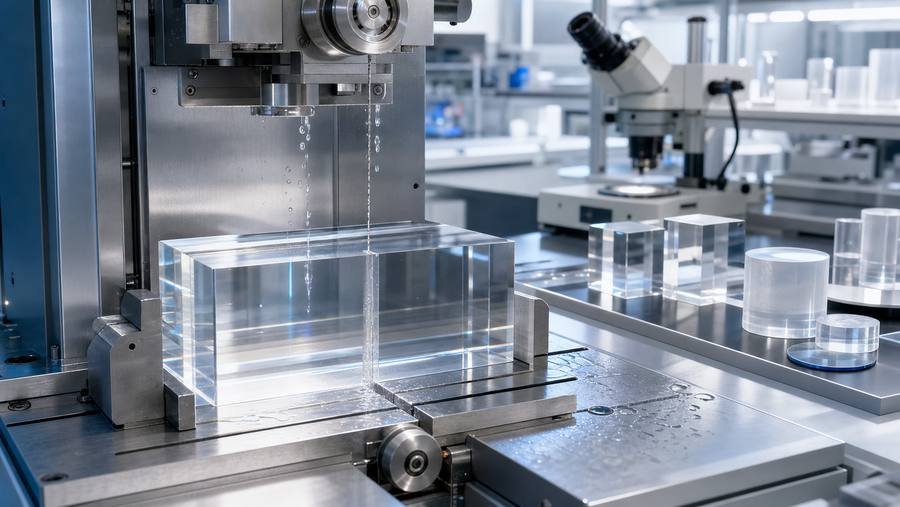
Why Optical Glass Cutting Requires Higher Precision
Optical materials are judged by more than shape. Edge quality, surface roughness, flatness, transparency and dimensional stability all influence downstream processing. A part may need grinding, polishing, coating, bonding or assembly into a sensitive optical system. If optical glass cutting introduces deep scratches or hidden cracks, later polishing must remove more material, which adds time and may change the final geometry.
Unlike many structural materials, optical glass rarely tolerates rough separation. Even when a cut surface will be polished later, excessive subsurface damage increases polishing allowance and cost. For thin glass panels, optical wafers and quartz components, a rough cut can also create handling risk. A controlled diamond wire saw process can make the next process step easier by starting from a cleaner edge and a narrower damage zone.
For procurement teams, this changes the buying question. The right equipment is not simply the fastest cutter. It is the system that produces acceptable cut quality at the lowest total cost, including polishing, inspection, material loss and yield.
Challenges in Quartz Glass Cutting and Optical Material Processing
Quartz glass cutting is difficult because quartz glass is hard, brittle and thermally stable. It does not absorb cutting energy in the same way as ductile materials, so unstable force can turn into chips or cracks. Quartz crystal cutting adds another concern: crystal orientation and internal stress may influence crack behavior and dimensional response.
Sapphire cutting is also demanding. Sapphire is extremely hard and can wear cutting tools quickly. Infrared optical materials and specialty glass may have their own sensitivities, such as brittleness, thermal shock risk or high raw material cost. These are all part of hard brittle material cutting, where the process must remove material without creating damage that later steps cannot afford.
Because optical materials are often expensive blanks, waste matters. Kerf loss, broken samples and excessive grinding allowance can all increase cost per usable component. A ceramic-style “cut first, fix later” mindset does not work well in precision glass cutting because later correction is expensive and sometimes impossible.
Common Defects in Optical Glass Cutting
Edge chipping is the most visible defect. It may appear as small fractures along the cut edge or larger breakout at corners. Chips can reduce usable area, create stress concentration and complicate handling. Microcracks and subsurface damage are more subtle. They may not be obvious at first inspection but can become critical during polishing, coating or thermal cycling.
Poor surface finish increases polishing load. If the cut face has deep grooves, random scratches or waviness, the polishing step must remove more material. This increases cycle time and can reduce dimensional accuracy. Cutting deviation is another issue. If wire motion is unstable, the cut may drift, creating wedge, thickness variation or shape error.
Material waste is the economic result of these defects. In optical glass cutting and quartz glass cutting, a rejected part is not only a lost blank. It also represents lost machine time, operator time and downstream capacity. A stable diamond wire saw process helps reduce this waste by controlling the cut before damage is created.
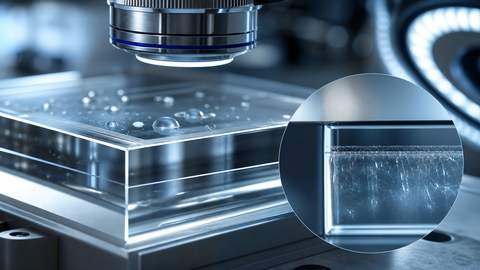
How Diamond Wire Saw Technology Improves Precision Glass Cutting
Diamond wire cutting uses a fine wire carrying diamond abrasive. For precision optical cutting, the value is low-stress material removal. The wire can create a narrow kerf and controlled contact zone when tension, speed and feed are stable. This helps reduce edge breakout and limits the depth of surface damage.
Stable wire speed matters because sudden changes in cutting rate can increase local force. Accurate tension control reduces wire bow and helps maintain geometry. Coolant removes heat and carries away glass powder, preventing debris from scratching the surface or loading the cut. Fixture design is also important because unsupported glass edges are more likely to chip at entry and exit points.
The technology does not remove the need for polishing, but it can reduce the amount of polishing required. For optical material cutting, that is a meaningful production improvement. Less polishing can mean shorter cycle time, lower consumable cost, better dimensional control and fewer parts lost to over-processing.
Choosing Between Endless Diamond Wire Saw, Diamond Multi-Wire Saw and Desktop Loop Saw
A desktop endless loop diamond wire saw is useful for laboratories, optical sample preparation and small-batch testing. It gives R&D teams a controlled way to evaluate quartz processing, sapphire cutting, thin glass panel cutting and other brittle optical materials without setting up a full production line.
Ein Endlos-Diamantdrahtsäge is often suitable for high-precision optical glass, quartz glass, sapphire and special crystal cutting. The continuous loop can support stable cutting behavior, flexible part shapes and careful parameter development. For expensive optical blanks, this flexibility is valuable because the cost of a failed cut may be higher than the cost of a longer setup.
A Diamant-Mehrdrahtsäge is preferred when the requirement is production output. It can slice multiple optical wafers, glass substrates or quartz plates in one cycle. For optical wafer processing, the diamond multi-wire saw must maintain equal wire spacing, stable tension and consistent coolant flow across the wire web. If those conditions are met, it can improve throughput while keeping cut geometry repeatable.
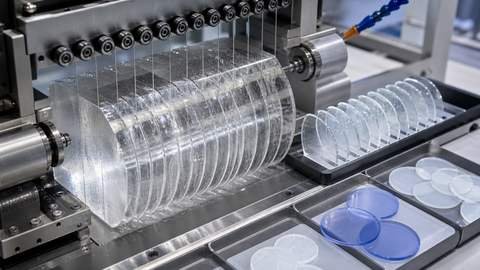
Key Selection Factors for Optical Glass and Quartz Cutting Equipment
Equipment selection should begin with the material: optical glass, quartz glass, quartz crystal, sapphire, infrared optical material or thin glass panel. Each material has different hardness, brittleness, thermal behavior and cost. The cutting equipment must also match the workpiece size, target thickness, tolerance and surface quality requirement.
Surface roughness and edge quality should be defined before the buying process starts. If the part requires low polishing allowance, the machine must offer stable feed control, wire tension control and coolant delivery. If the part is a thick optical block, fixture rigidity and wire tracking become important. If the part is a thin wafer, thickness variation and handling support may define yield.
Consumables are part of the decision. Diamond wire diameter, grit size, bonding quality and wire life influence kerf, surface finish and operating cost. Coolant filtration, guide rollers, workholding and cleaning steps should be evaluated as part of the process. For hard brittle material cutting, the machine and consumables cannot be separated.
Finally, consider process support. When defects appear, the cause may be wire wear, feed force, coolant starvation, fixture design, material stress or guide condition. A supplier that understands diagnosis and parameter optimization can reduce trial-and-error time during ramp-up.
Applications of Diamond Wire Saw in Optical and Photonic Materials
Diamond wire cutting technology is used for optical glass slicing, quartz glass cutting, quartz crystal cutting, sapphire substrate processing, infrared optical components, precision optical wafer processing and thin glass panel cutting. These applications often serve photonics, semiconductor tooling, optical communication, laser systems, sensors and precision instruments.
In each case, the goal is not only to cut the material. The goal is to preserve enough edge and surface quality so the next step can proceed with less waste. When the cutting process reduces subsurface damage and kerf loss, the factory can improve material utilization and shorten downstream finishing time.
How ewirexon Supports Precision Optical Material Cutting Applications
Ewirexon provides diamond wire cutting solutions for hard and brittle materials, including continuous-loop diamond wire equipment, multi-wire slicing systems, desktop loop saw machines, consumables and auxiliary processing equipment. Its application scope includes quartz crystal and optical glass slicing, sapphire substrate fine cutting, semiconductor materials, advanced ceramics, thin glass and other precision materials.
For optical material projects, the useful starting point is the real process requirement. A research lab cutting a few quartz samples may need flexibility and easy parameter adjustment. A manufacturer slicing optical wafers may need repeatability, higher throughput and consumable control. Ewirexon can support equipment selection and process discussion around material type, workpiece size, tolerance, surface requirement and production target.
Fazit
Diamond wire cutting technology improves optical material cutting and quartz processing by reducing cutting stress, narrowing kerf, improving edge quality and lowering the amount of downstream polishing required. For R&D and special optical parts, a continuous-loop wire saw can provide flexible, controlled cutting. For volume optical wafer processing, a multi-wire slicing system can support throughput when the process is stable.
The right solution should be selected from the part requirement, not from a machine name alone. Before requesting a proposal, prepare the material type, dimensions, thickness tolerance, edge requirement, surface quality target, expected batch size and current cutting defects. With that information, it becomes much easier to choose equipment that supports yield, surface quality and long-term cost control.
Häufig gestellte Fragen
What is the best method for optical glass cutting?
For many precision optical material cutting applications, diamond wire saw technology is a strong option because it supports low-stress cutting, narrow kerf and better edge control. The best machine type depends on part size, tolerance and production volume.
Why is quartz glass cutting difficult?
Quartz glass cutting is difficult because quartz glass is hard, brittle and resistant to deformation. Unstable cutting force can create edge chips, microcracks and subsurface damage that increase polishing cost and reduce yield.
How does a diamond wire saw improve surface quality?
A diamond wire saw improves surface quality by using controlled abrasive cutting with stable wire speed, tension and coolant. This can reduce surface scratches, edge breakout and hidden damage compared with more aggressive cutting methods.
Can diamond wire saw be used for sapphire cutting?
Yes. Sapphire cutting is a common hard brittle material cutting application for diamond wire technology. Because sapphire is very hard, the process must control wire wear, feed rate, coolant and fixture support carefully.
How to choose cutting equipment for hard brittle optical materials?
Start with material type, size, thickness tolerance, edge quality, surface finish, polishing allowance and production volume. Then compare continuous-loop wire saw, multi-wire slicing system and desktop loop saw options based on process stability, consumable cost and supplier support.