










Quartz crystal, fused silica, borosilicate glass, K9 optical glass and infrared optical materials are essential in optics, photonics, sensors, laser systems, semiconductor equipment and precision instruments. These materials must often be sliced into wafers, windows, blanks or custom shapes before polishing and coating. The challenge is that transparent brittle materials reveal almost every processing mistake.
Edge chips, microcracks, scratches and thickness variation can reduce optical yield or increase polishing time. For this reason, many optics manufacturers evaluate Diamantdrahtsäge technology for quartz crystal slicing und optical glass slicing.
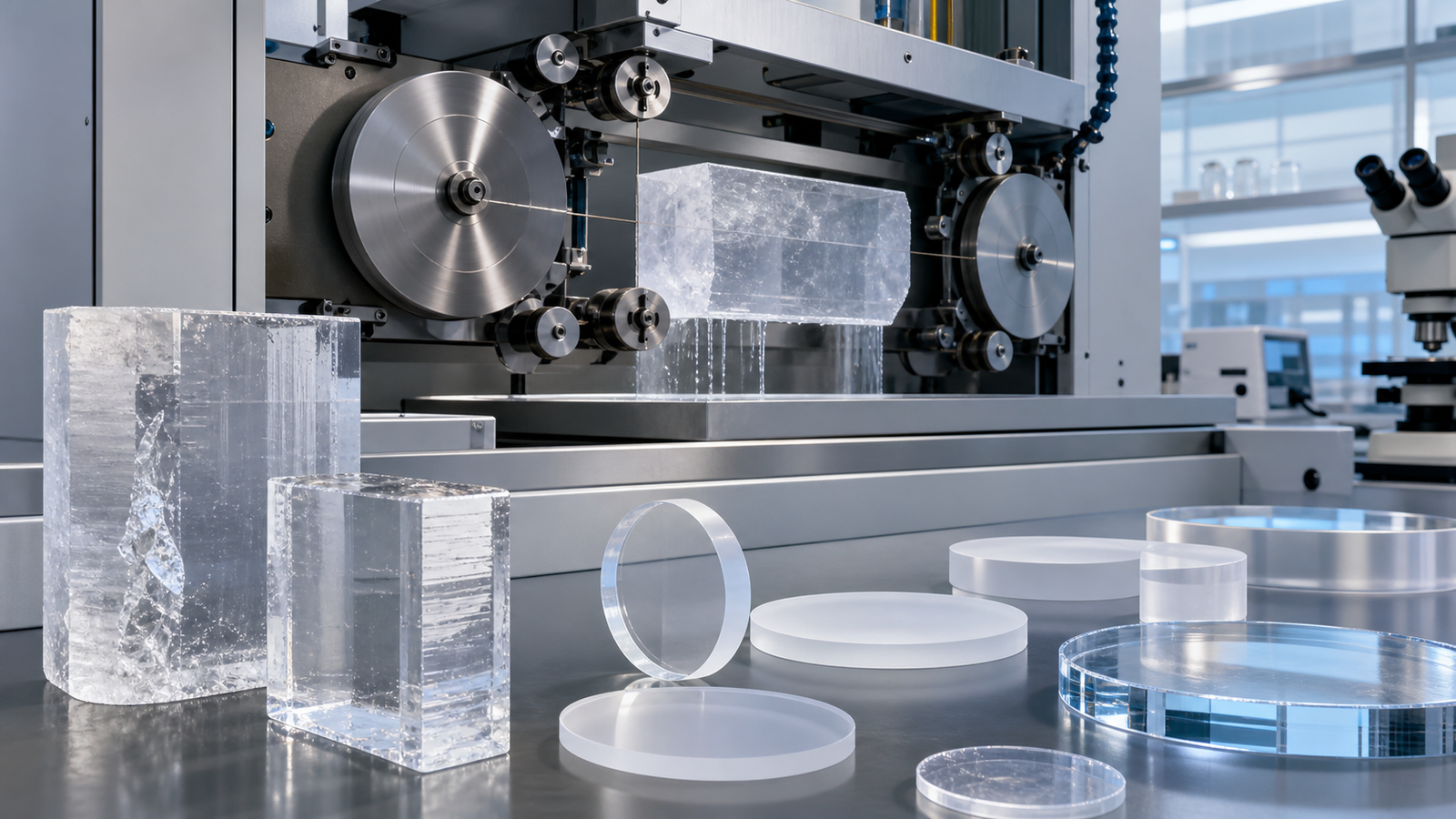
Why Optical Materials Need Low-Stress Cutting
Optical materials are often brittle and sensitive to edge defects. A small chip at the edge of a glass blank can grow during grinding or thermal treatment. A subsurface crack may force additional material removal during polishing. Scratches or debris marks can affect coating quality and final optical performance.
Cutting stress is especially important because these materials may be transparent but not mechanically forgiving. If the saw creates vibration, excessive heat or poor debris evacuation, defects can form before the optical surface is even polished.
The business issue is straightforward: cutting damage increases polishing time and lowers usable yield. For expensive optical blanks or quartz components, reducing early-stage damage can be more valuable than increasing cutting speed alone.
Common Problems in Quartz and Optical Glass Cutting
Edge chipping is the most visible problem. It can occur when the material is not supported close enough to the cut or when the feed rate creates too much local force. Because optical parts often require clean edges, chipping can create rework or scrap.
Kerf loss matters when slicing high-value blanks. A narrow kerf improves material utilization, but only if the wire remains stable. Wire bow can create dimensional errors even with a fine wire.
Surface scratches and glass debris are also important. If particles stay inside the cut, they can damage the surface and increase polishing burden. Coolant direction, filtration and debris removal must be designed around the material and part geometry.
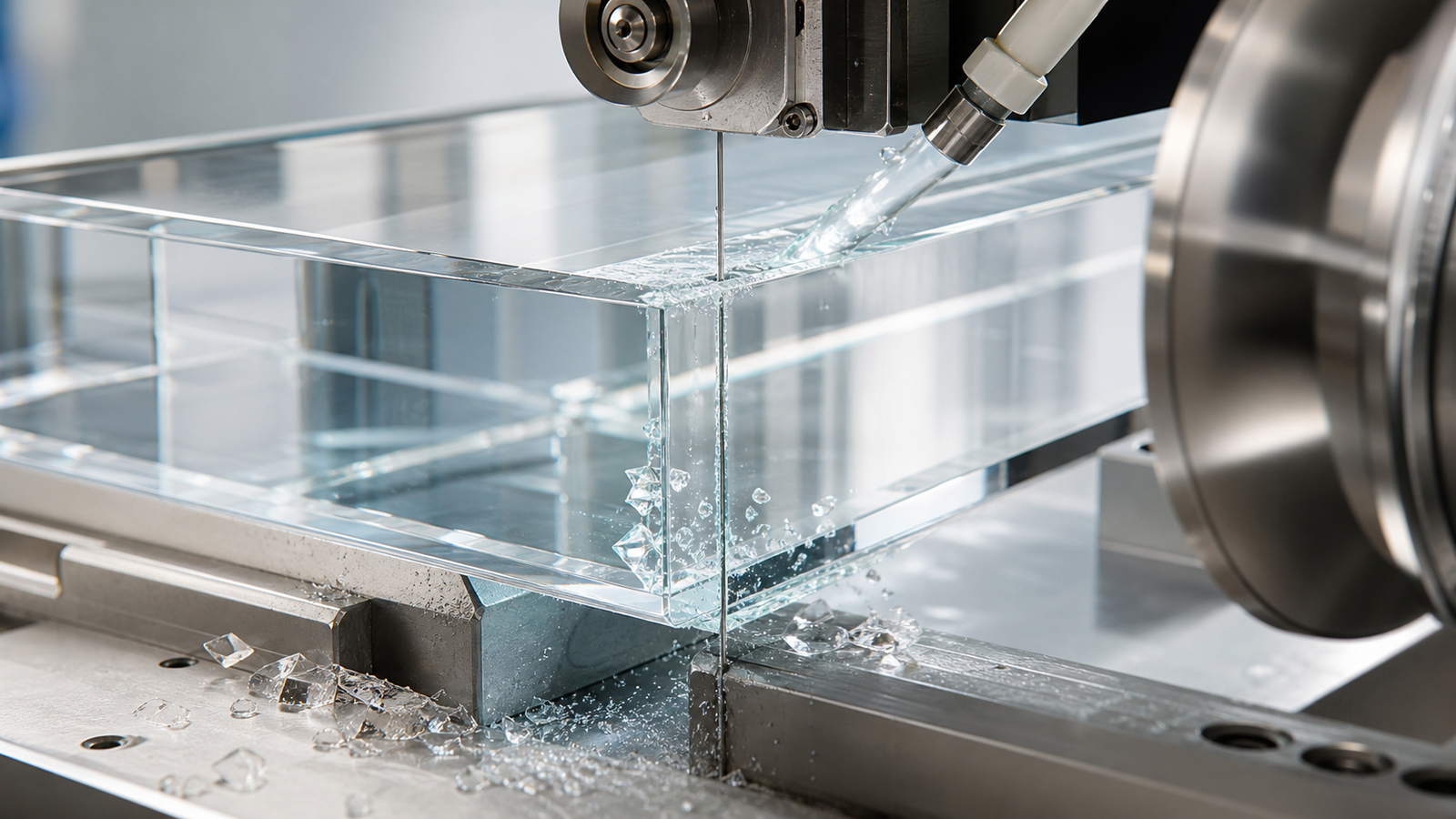
How Precision Diamond Wire Saw Technology Helps
A Präzisions-Diamantdrahtsäge cuts by controlled abrasion rather than heavy impact. The fine diamond wire can reduce cutting force and kerf width, which is valuable for fragile optical materials. With stable tension and feed control, the process can produce cleaner edges and more predictable thickness.
Ein Endlos-Diamantdrahtsäge is useful for optical glass blanks, quartz crystal samples and custom shapes because it offers flexible low-stress cutting. For repeated wafer slicing, a multi-wire configuration may be used when higher output and consistent thickness are required.
Coolant strategy is central. Coolant must cool the cutting zone, carry away glass particles and avoid introducing contamination. For optical materials, clean process conditions matter because debris can create scratches that later become expensive polishing defects.
What to Specify Before Requesting a Cutting Solution
Engineers should define material type, blank size, target thickness, edge quality, surface roughness, allowable subsurface damage and whether the part will be polished, coated or bonded later. For optical components, downstream process information helps determine how gentle the cutting process must be.
Procurement teams should compare process support, not only machine travel range. Ask whether the supplier can test the material, recommend wire specifications, design fixtures and advise on coolant and filtration. Ewirexon鈥檚 quartz crystal and optical glass slicing page and infrared optical component cutting page are relevant internal application references.
For laboratories, a desktop endless loop diamond wire saw can be useful for experimental optical materials and prototype blanks. For factories, repeatability, maintenance access and consumable stability should be evaluated through trial cuts.
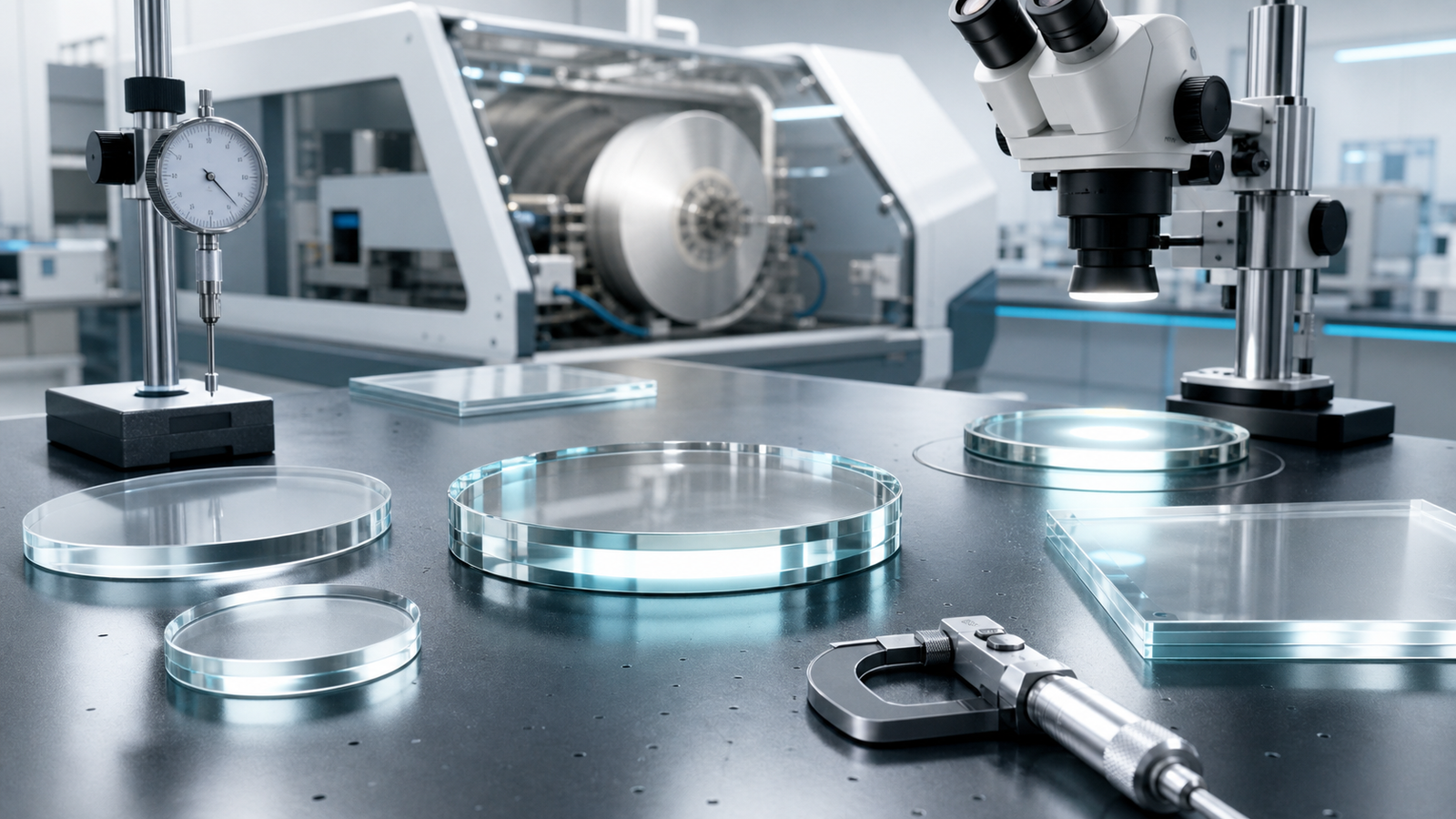
Process Priorities for Optical Material Manufacturers
Optical material cutting should be judged by what happens after slicing. If the cut edge requires heavy grinding, if the surface carries scratches into polishing, or if thickness variation creates extra lapping time, the slicing process is already increasing total cost. For this reason, optics manufacturers should measure cutting performance across the full workflow, not only by the time required to separate a blank.
Important inspection points include edge chip size, flatness, thickness variation, surface scratches, remaining allowance for polishing and contamination from coolant or debris. Transparent materials make defects easier to see, but they can also hide subsurface cracks that only appear under stress or later processing. A stable diamond wire saw process reduces the chance of carrying these defects forward.
Fixture design is often underestimated. Optical glass blanks may be rectangular, round, thick, thin or fragile at the edges. Poor support can create vibration or uneven pressure. A well-designed fixture reduces movement, protects the blank and helps the wire follow a predictable path.
How Ewirexon Supports Quartz and Optical Glass Slicing
Ewirexon鈥檚 precision diamond wire cutting systems are used across brittle optical materials, including quartz crystal, fused silica, optical glass and infrared optical blanks. This application experience is useful because optical cutting often requires a balance between dimensional accuracy, surface protection and low material loss.
An endless diamond wire saw is well suited for prototype blanks, R&D samples and custom optical shapes where flexibility is important. For repeated wafer or plate slicing, a production system can be configured around throughput, wire life and inspection requirements. If the material is unusual, cutting trials are the safest path to define coolant strategy, wire specification and feed conditions.
Before ordering equipment, share material type, dimensions, optical grade, target thickness, polishing allowance, surface requirement and any coating or bonding steps after slicing. These details help determine how gentle the cutting process must be and whether auxiliary processing equipment is needed.
Total Cost Thinking for Optical Cutting
In optics manufacturing, the cutting machine is only one part of the cost. Polishing time, coating yield, rejected blanks and inspection labor often matter more. A diamond wire saw process that reduces edge chips and surface scratches can lower the total cost even if the cutting cycle is not the fastest possible.
Engineers should track defects by type: edge breakout, surface scratches, thickness variation, subsurface cracks and contamination. This makes it easier to decide whether the cause is wire wear, coolant quality, feed force, fixture support or material handling. Without this feedback loop, teams often adjust parameters blindly.
Buyers should also consider flexibility. Optical workshops may process fused silica one week, quartz crystal the next and infrared materials after that. A machine with adaptable fixturing, stable wire control and supplier process support is often more valuable than a system optimized for only one ideal sample.
Checkliste vor dem Kauf für Schnittversuche
Bevor Sie ein Schneidsystem freigeben, sollten Sie einen strukturierten Test durchführen, anstatt sich ausschließlich auf die Angaben im Katalog zu verlassen. Bereiten Sie repräsentative Materialproben vor, legen Sie die gewünschte Dicke und die Anforderungen an die Schnittkanten fest und vereinbaren Sie, wie die Ergebnisse geprüft werden sollen. Bei dem Test sollten die Schnittbreite, die Schnittzeit, der Zustand des Drahtes, die Schnittkantenqualität, der Oberflächenzustand sowie etwaige Anzeichen für verborgene Schäden erfasst werden.
Bitten Sie den Lieferanten, die Ausgangsparameter zu erläutern und zu erklären, warum diese gewählt wurden. So kann Ihr Ingenieurteam besser nachvollziehen, ob der Prozess auf dem Materialverhalten basiert oder lediglich auf einer Standard-Maschinenrezeptur. Sollte das erste Ergebnis nicht optimal sein, sollte der Lieferant erklären können, welcher Parameter als Nächstes angepasst werden sollte und mit welchen Kompromissen zu rechnen ist.
Bei Werken im Ausland sollten zudem die Installation, Ersatzteile, Schulungen und die Fernfehlerbehebung berücksichtigt werden. Präzisionsschneidanlagen schaffen nur dann einen Mehrwert, wenn die Bediener den Prozess nach der Inbetriebnahme stabil halten können. Eine gute Kaufentscheidung vereint daher Maschinenleistung, Verbrauchsmaterialstrategie und langfristige Prozessunterstützung.
Technischer Hinweis
In der Praxis wird das beste Schneidresultat in der Regel nicht durch einen einzigen aggressiven Parameter erzielt. Es ist vielmehr das Ergebnis eines ausgewogenen Prozesses: stabile Drahtbewegung, kontrollierter Vorschub, geeignete Werkstückaufspannung, saubere Späneabfuhr und Rückmeldungen aus der Qualitätskontrolle. Die Betrachtung dieser Variablen als ein Gesamtsystem ist der zuverlässigste Weg, um die Ausbeute zu sichern und die Gesamtverarbeitungskosten zu senken.
This is why engineering teams should review cutting data, finished-part inspection and consumable behavior together before locking the final equipment configuration.
Häufig gestellte Fragen
Can diamond wire saw cut quartz crystal and optical glass?
Yes. Diamond wire saw systems can cut quartz crystal, fused silica, optical glass and related brittle optical materials when the wire, feed rate, coolant and fixture are properly selected.
Why is low-stress cutting important for optical glass?
Low-stress cutting reduces edge chipping, microcracks and scratches that would increase polishing time or reduce optical yield.
Does diamond wire cutting reduce kerf loss?
It can. Fine diamond wire creates a narrow cutting path, but real kerf loss reduction depends on stable tension, low vibration and good debris removal.
What equipment is useful for optical material R&D?
A desktop endless loop diamond wire saw or compact endless diamond wire saw is useful for sample cutting, prototype blanks and process trials.
What information should be provided for an optical glass cutting test?
Provide material type, blank dimensions, target thickness, edge requirement, surface finish target, downstream polishing process and current cutting defects.